•
•
•
•
•
•
•

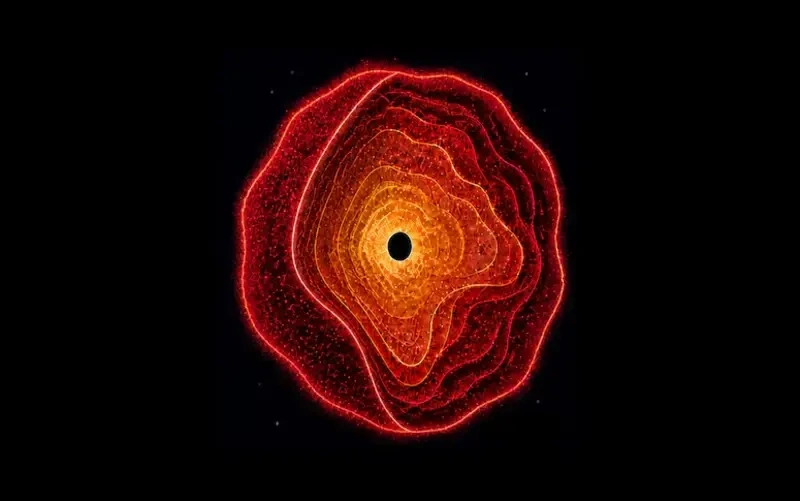
Astronomers using the James Webb Space Telescope (JWST) have identified what they describe as a genuinely new class of cosmic object: a "black hole star," in which a supermassive black hole sits inside a thick, glowing cocoon of gas so dense that the whole structure radiates almost like the atmosphere of an enormous star, rather than behaving like a typical quasar or accretion disk. Researchers involved in the discovery, including a team affiliated with MIT, described the object as roughly a hundred billion times brighter than the Sun.
The object belongs to a population of extremely compact, extremely red sources nicknamed "little red dots" — objects JWST has been spotting in large numbers since it began surveying the early universe. Little red dots have puzzled astronomers since their discovery because their light signatures don't cleanly match either an ordinary young galaxy or a standard actively feeding black hole (quasar).
The new research proposes an explanation: at the center of at least some little red dots sits a supermassive black hole surrounded not by a thin accretion disk, but by an extremely thick, near-spherical envelope of hot gas. This gas envelope reprocesses the black hole's intense radiation and re-emits it in a way that mimics the spectral signature of a cool, giant star — hence "black hole star" — even though the object is powered by black-hole accretion at its core rather than nuclear fusion.
Little red dots were first flagged as a distinct population in JWST imaging shortly after the telescope began science operations in 2022, and they have remained one of the more persistent puzzles in early-universe astronomy. Their unusual color and compactness led to competing explanations, including the possibility that some were simply dusty starburst galaxies or standard active galactic nuclei viewed at an unusual angle. The "black hole star" model instead proposes a distinct physical structure — an optically thick gas envelope around a black hole — that had not previously been described as a formal class of object.
If confirmed and generalized across the little red dot population, the discovery would give astronomers a new physical model for how supermassive black holes grow in the early universe. Understanding how black holes accumulate mass quickly enough to become "supermassive" within the universe's first billion years remains one of astrophysics' open problems, and a thick, star-like gas envelope could represent an early, rapid-growth phase that is short-lived and therefore rarely observed in nearby galaxies.
Astronomers are expected to search JWST's existing and upcoming deep-field survey data for additional candidate "black hole star" objects to test whether the model holds across a larger sample. Follow-up spectroscopic observations at different wavelengths, along with theoretical modeling of how such a gas envelope could remain stable, are likely next steps to confirm the interpretation and refine estimates of the black holes' masses and growth rates.
What is a "little red dot"?
It's an informal name astronomers use for a population of small, extremely red, compact objects discovered in JWST deep-field images, whose true nature (young galaxy, obscured quasar, or something else) has been debated since their discovery.
Is a "black hole star" actually a star?
No. It is not powered by nuclear fusion like a real star. The name describes an observational resemblance — a black hole surrounded by a gas envelope that emits light with a spectral signature similar to a giant star's atmosphere — rather than indicating it is stellar in nature.
How far away is this object?
Little red dots, including candidates for this new class, are typically observed at very high redshift, corresponding to when the universe was under a billion years old, making them some of the most distant and earliest black hole systems observed.
Why couldn't earlier telescopes find these objects?
Their light is heavily redshifted and relatively faint at the wavelengths older telescopes like Hubble were most sensitive to. JWST's infrared instruments are specifically suited to detecting and characterizing this population.
The identification of "black hole star" objects gives astronomers a new candidate explanation for one of JWST's most persistent early-universe puzzles, and a possible window into how supermassive black holes grow so quickly after the Big Bang. As with most single-study findings in observational astronomy, broader confirmation across additional objects will determine how well the model holds up.