•
•
•
•
•
•
•

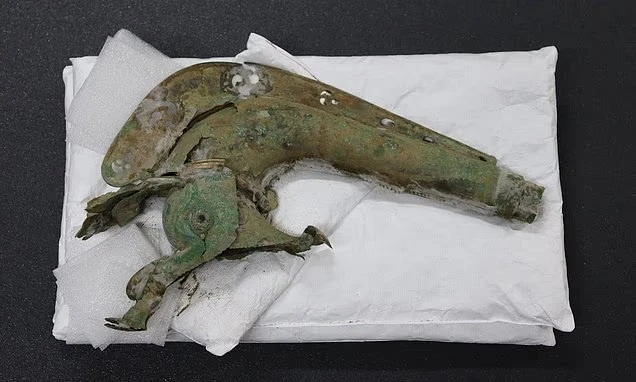
Archaeologists in Britain have unveiled what is being called one of the most significant Iron Age discoveries made in Europe in decades: a hoard of ceremonial and martial bronze objects unearthed during a routine excavation ahead of a housing development in west Norfolk, England.
At the center of the find, now known as the Norfolk Carnyx Hoard, is a near-complete carnyx — a dramatic, animal-headed bronze war trumpet used by Celtic tribes across Iron Age Europe to intimidate enemies and rally warriors in battle. Only two other carnyces have previously been recorded in Britain, and this example is considered one of the most complete ever recovered on the continent.
Alongside the trumpet, excavators recovered fragments of a second carnyx, a sheet-bronze boar's head believed to have topped a military standard — the first such object ever found in Britain — as well as five shield bosses and an iron object whose original purpose remains unclear. The assemblage is thought to date to the 1st century AD.
The hoard was uncovered by commercial heritage specialists Pre-Construct Archaeology during a standard planning-process excavation on privately owned land, with the dig conducted during the summer of last year. Rather than removing individual pieces on site, the fragile assemblage was lifted intact within a block of surrounding soil to preserve its archaeological context, and has since undergone non-invasive X-ray and CT imaging to map its contents before conservators begin delicate hands-on work.
Because Celtic tribes are known to have inhabited the region, some researchers have floated a possible connection to the era of Boudicca, the British queen who led a major revolt against Roman occupation. Conservation and research are continuing in partnership with Historic England, Norfolk Museums Service, and National Museums Scotland, and the find has already featured in a televised archaeology program in the UK.
Beyond Norfolk, 2026 has already produced a wave of notable finds reshaping understanding of ancient and medieval life — from a Byzantine-era monastic complex uncovered in Upper Egypt to a late Roman mosaic featuring a Solomon's knot motif discovered beneath the modern Turkish city of İzmir. Together, these discoveries underscore how routine construction and planning excavations continue to surface major pieces of the historical record.