•
•
•
•
•
•
•

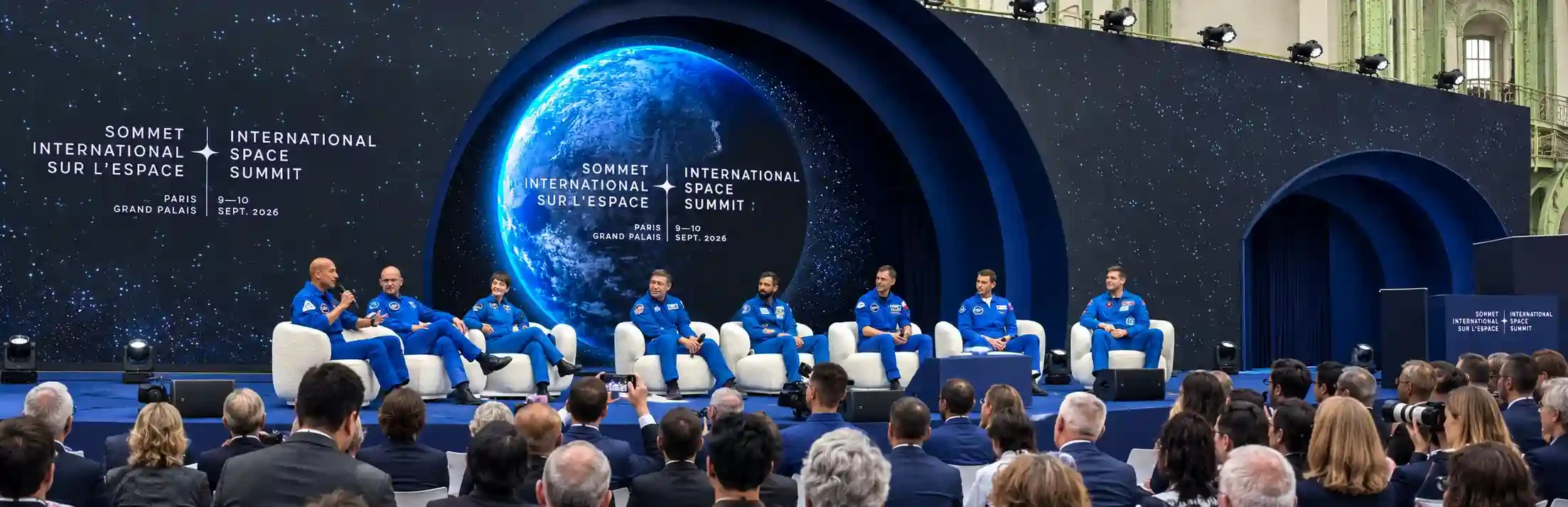
The International Space Summit has begun in Paris, bringing together governments, space agencies, scientists and private companies to discuss the future of space exploration, satellite technology and space security.
The two-day summit, hosted by French President Emmanuel Macron, is focused on strengthening international cooperation and giving Europe a stronger position in the global space industry.
Around 90 countries are taking part, with more than 50 projects expected to be announced or signed.
Discussions are focusing on satellite communications, Earth observation, space security, rocket launches and future missions to the Moon and Mars.
Space is becoming increasingly important not only for scientific research but also for communications, navigation, climate monitoring and national security.
Europe is also trying to reduce its dependence on other countries and private companies for important space services. The rapid growth of companies such as SpaceX has increased pressure on Europe to develop stronger independent space capabilities.
One key focus is IRIS², Europe's planned secure satellite communication network, which aims to improve Europe's independent communication infrastructure.
Amazon has also announced six additional Ariane 6 launches, increasing its total order to 24 launches through 2031. The deal provides a major boost to Europe's Ariane rocket programme.
The UAE has committed $1 billion to a French space-AI project involving a planned constellation of 50 satellites. These satellites could use AI to process information in orbit and help monitor events such as wildfires and infrastructure damage.
India is participating in the summit, with ISRO Chairman V. Narayanan leading the Indian delegation.
Prime Minister Narendra Modi has also addressed the summit virtually and called for stronger partnerships between India, France and other countries in future space research and exploration.
The summit continues with discussions on space security, satellite technology, European competitiveness and future exploration.
The bigger challenge will be turning the announcements into actual satellites, rockets, investments and long-term partnerships.
The Paris summit could therefore play an important role in deciding how Europe and its international partners prepare for the next era of space exploration, including future missions to the Moon and eventually Mars.