•
•
•
•
•
•
•

Ever wondered why we say “hello” when answering the phone? The story begins with Alexander Graham Bell, “ahoy,” Thomas Edison and the rise of the telephone.
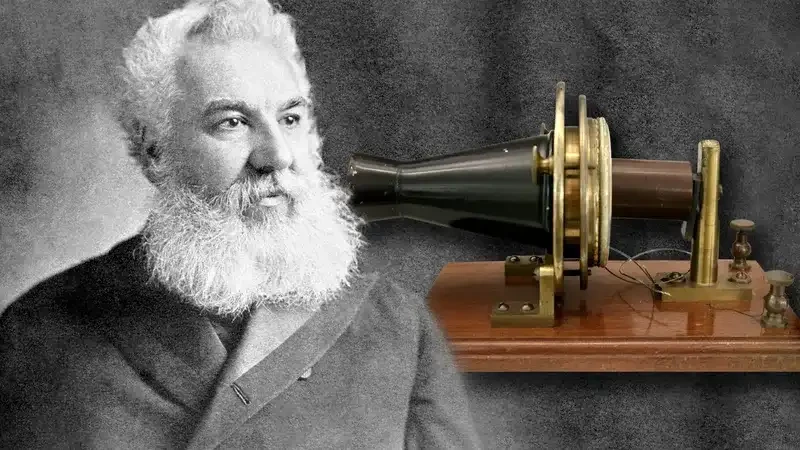
Imagine receiving a telephone call in the late 19th century.
There is no caller ID. No smartphone screen tells you who is calling. There may not even be a familiar ringtone. You simply hear the telephone ring, pick up the receiver and suddenly have to figure out how to begin a conversation with someone who might be miles away.
Today, most of us instinctively say “Hello?”
It feels so ordinary that we rarely stop to ask where the habit came from.
But “hello” was not originally created for telephones. The word existed before the invention of the telephone, and it gradually became associated with getting someone's attention and starting a conversation.
The telephone helped transform it into one of the world's most recognizable greetings.
And surprisingly, the man credited with inventing the telephone was not the person who popularized “hello” as the standard telephone greeting.
The story begins with Alexander Graham Bell, the Scottish-born inventor and teacher who became closely associated with the development of the telephone.
Bell was fascinated by speech, sound and hearing from an early age. His father and grandfather were both involved in teaching speech and elocution, and Bell later worked with deaf students.
During the 1870s, he experimented with ways of transmitting human speech electrically.
On March 7, 1876, Bell received U.S. Patent No. 174,465 for an invention described as an improvement in telegraphy that could transmit vocal sounds. The Library of Congress credits Bell with the telephone's first patent and with developing the invention into a working device, although the history also involved other inventors, particularly Elisha Gray, who was working on related technology.
Just three days after receiving the patent, Bell conducted one of the most famous experiments in communication history.
On March 10, 1876, Bell spoke to his assistant, Thomas Watson, through the experimental telephone.
His famous words were:
“Mr. Watson — come here — I want to see you.”
Watson heard Bell's voice and came to him.
It was a small sentence that represented a huge technological breakthrough: for the first time, spoken words had successfully travelled electrically from one location to another through Bell's experimental telephone.
But Bell apparently did not think “hello” should become the standard telephone greeting.
This is where the story gets interesting.
Bell reportedly preferred the word “ahoy” as a telephone greeting.
Yes — “ahoy,” the word associated with sailors calling out to ships.
The word had existed long before the telephone and was commonly used as a way of attracting someone's attention. Bell believed it was suitable for telephone conversations because a caller needed a short, recognizable word to establish contact.
The Library of Congress notes that Bell initially recommended “ahoy” for telephone use.
So, if Bell had gotten his way, answering a telephone might have sounded very different.
Instead of:
“Hello?”
we might have been saying:
“Ahoy!”
every time the phone rang.
Fortunately — or unfortunately, depending on your taste in nautical greetings — another famous inventor had a different idea.
That inventor was Thomas Alva Edison.
Edison was not the inventor of the telephone. However, he made important improvements to telephone technology, particularly the transmitter. The Library of Congress notes that his work produced a transmitter capable of transmitting voices at greater volume and clarity over telephone lines.
Edison also became involved in the practical question of how people should begin telephone conversations.
His preferred word was “hello.”
And that simple choice had an enormous cultural impact.
According to the Library of Congress, Bell preferred “ahoy,” while Edison recommended “hello” — and “hello” ultimately stuck.
There was an important practical problem with the early telephone.
When people first started using the technology, there were no established rules for telephone etiquette.
People had to figure out basic questions:
“Hello” was particularly useful because it was short, recognizable and could be spoken clearly.
As telephone networks expanded, consistent telephone etiquette became increasingly important.
The word gradually became associated with answering the telephone.
The development of telephone exchanges also helped establish the habit. Early telephone users often depended on operators to connect calls rather than dialing numbers themselves. The first telephone directory, published in New Haven in 1878, contained only 50 listings and did not use telephone numbers in the modern sense.
As telephone use expanded, so did the need for standardized ways of communicating.
And “hello” proved remarkably effective.
There was nothing magical about the word.
Its success came from several practical advantages.
“Hello” was already used to attract someone's attention.
That made it suitable for a device where the person on the other end might not know immediately who was speaking.
Telephone conversations require words that can be understood quickly, particularly when early connections were not as clear as modern calls.
“Hello” is brief and easy to recognize.
When a telephone rings, you don't necessarily know who is on the other end.
“Hello?” works whether the caller is a friend, family member, business associate or stranger.
Once enough people began using the word, it became self-reinforcing.
New telephone users heard other people saying “hello,” copied them and passed the habit on.
Eventually, the greeting became part of telephone culture.
The fascinating part is that “hello” eventually escaped the telephone.
Today, we say hello when meeting people face-to-face, starting conversations, answering video calls and sometimes even entering a room.
The telephone didn't invent the word, but it helped give “hello” a powerful new cultural role.
The technology effectively transformed an attention-getting expression into a universal conversational opening.
The word also became strongly connected with the idea of answering a call.
For generations, people grew up learning the same simple routine:
Telephone rings → pick up receiver → say “hello.”
It became almost automatic.
The rise of the telephone fundamentally changed how people interacted.
Before it, long-distance communication depended heavily on letters and telegraph messages. The telegraph could send information quickly, but it generally required coded messages rather than natural spoken conversation.
The telephone introduced something fundamentally different: real-time voice communication.
Bell himself understood the potential of the invention.
After his successful experiment with Watson, he predicted that telephone wires would eventually reach homes and allow friends to converse without leaving their houses. The Library of Congress notes that this prediction proved remarkably accurate; by 1906, more than 2.5 million American homes had telephones.
The technology continued evolving from direct lines to exchanges, from switchboard operators to dialing systems, and eventually from landlines to mobile phones and internet-based calling.
Yet one tiny piece of the early telephone era survived almost unchanged:
“Hello?”
The story of “hello” demonstrates how technological revolutions can create new social habits.
Alexander Graham Bell helped establish the technology that made voice communication over distance possible. Thomas Watson was the recipient of Bell's famous first successful telephone message. Thomas Edison improved telephone technology and promoted “hello” as a greeting.
And somewhere along that journey, “hello” defeated “ahoy.”
Today, billions of people use some version of “hello” without thinking about its history.
We say it when we answer a phone. We say it when meeting someone. We say it when starting a conversation. We even type it in text messages.
The word has become so ordinary that its extraordinary history is easy to forget.
So the next time your phone rings and you instinctively say “hello,” remember that you are participating in a tradition that goes back to the earliest days of telephone communication — when inventors were still figuring out not only how to transmit a human voice, but also what humans should say when that voice arrived from the other end of a wire.
And as history tells us, it could very easily have been:
“Ahoy!”