•
•
•
•
•
•
•

Virtual reality (VR) is transforming gaming, education, healthcare, training and business by placing users inside interactive computer-generated environments.
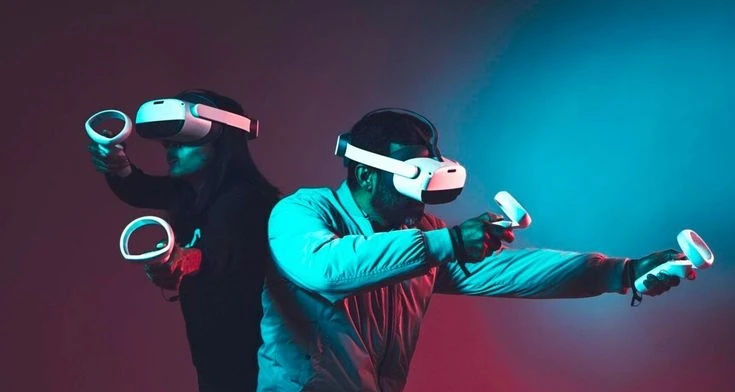
Imagine putting on a headset and suddenly finding yourself inside a completely different environment. You can look around, move your head, interact with virtual objects and, in some systems, use your hands to manipulate the digital world.
That is the basic idea behind virtual reality.
Virtual reality, commonly known as VR, is a technology that creates a computer-generated environment designed to give users an immersive and interactive experience. Instead of simply viewing information on a conventional screen, users can become part of a simulated digital environment.
Modern VR combines technologies such as head-mounted displays, motion tracking, sensors, computer graphics, audio and interactive controls to create the illusion of being inside a digital world.
While VR is strongly associated with gaming, its applications now extend to education, healthcare, engineering, manufacturing, architecture, real estate, tourism, entertainment and professional training.
The core objective of VR is to replace or significantly alter the user's visual and sensory environment with a computer-generated one.
A typical VR system consists of several important components.
The VR headset is the primary device users wear. It contains displays, lenses, cameras and motion sensors that help generate the virtual environment.
Instead of looking at a television or smartphone screen, the user views digital images through the headset. The system presents slightly different images to each eye, helping create a sense of depth and three-dimensional space.
Motion tracking allows the virtual environment to respond to the user's movements.
When you turn your head, for example, the virtual scene changes accordingly. More advanced systems can track body, hand and controller movements.
A technology known as 6DoF (six degrees of freedom) allows users to move through a virtual space rather than simply looking around from a fixed position.
Many VR platforms use handheld controllers, while newer systems can recognize hand movements directly.
These input methods allow users to interact with virtual objects, select menus, operate equipment and perform actions inside digital environments.
Hardware alone cannot create VR.
Specialized software generates the 3D environments, objects, animations, physics, sound and interactions that users experience. Game engines and dedicated VR development platforms are commonly used to build these environments.
Spatial or positional audio is another important part of immersion. Sounds can appear to come from particular directions, helping users understand where virtual events are taking place.
Virtual reality is often confused with augmented reality (AR) and mixed reality (MR). Although the technologies overlap, they provide different experiences.
| Technology | How it works | Example |
|---|---|---|
| VR | Replaces the user's surroundings with a digital environment | VR gaming |
| AR | Adds digital information to the physical world | Navigation overlays |
| MR | Combines physical and digital environments with interaction | Virtual objects interacting with a real room |
In simple terms, VR takes you into a digital environment, while AR adds digital elements to the real world. Mixed reality combines aspects of both approaches.
Although today's VR headsets look like modern consumer technology, the concept has been developing for decades.
One important milestone came in the 1960s, when computer scientist Ivan Sutherland developed an early head-mounted display capable of displaying basic computer-generated graphics.
VR technology continued developing through increasingly sophisticated displays, computer graphics, tracking systems and interactive hardware.
The technology gained significant attention in gaming and entertainment, particularly as consumer VR headsets became more accessible.
Today, VR is moving beyond gaming into professional environments where realistic simulations can provide practical advantages.
One of the most interesting aspects of VR is the number of industries using or experimenting with immersive technology.
Gaming remains one of the most recognizable applications of virtual reality technology.
Instead of controlling a character from outside the game world, VR can place the player directly inside the environment.
Users can look around naturally, interact with virtual objects and physically move within supported experiences.
VR is also being explored for virtual concerts, immersive movies and interactive entertainment.
VR can allow students to experience situations that would otherwise be difficult, expensive or dangerous to reproduce.
For example, students can explore:
This makes VR education and virtual training particularly useful for learning through simulation.
Healthcare is another important area for VR.
Medical professionals can use virtual environments for training and simulation, while certain VR-based applications are being explored for therapy and pain management.
The major advantage is that some procedures and scenarios can be practiced in a controlled virtual environment before being performed in real-world situations.
Industrial companies can use VR to train employees without requiring them to immediately work with expensive machinery or potentially hazardous equipment.
Virtual simulations can recreate industrial environments and allow employees to practice procedures.
TeamViewer, for example, describes VR and related immersive technologies being used for training, manufacturing, logistics and other professional applications.
VR can change how people experience buildings before they physically exist.
Architects and developers can create virtual walkthroughs, allowing clients to explore rooms, layouts and spaces from inside a digital model.
For real estate, VR can also provide virtual property tours, allowing potential buyers or renters to explore spaces remotely.
Virtual reality can provide digital tours of destinations, hotels, museums and attractions.
A traveler could potentially explore a location virtually before deciding whether to visit it physically.
This makes virtual tourism another interesting application of immersive technology.
The biggest advantage of VR is immersion.
Traditional digital content is viewed through a screen. VR can make users feel as though they are physically present inside the digital environment.
Some major benefits include:
Students can learn through interactive simulations rather than only reading or watching demonstrations.
Dangerous or expensive situations can potentially be simulated without exposing trainees to the same real-world risks.
VR can create shared virtual spaces where people in different locations can meet, train or work together.
Architects, engineers and designers can experience digital models at a more realistic scale.
VR offers interactive gaming and entertainment formats that conventional screens cannot completely replicate.
Despite its potential, VR still faces several challenges.
High-quality VR hardware and software development can be expensive, particularly for professional applications.
Some users experience motion sickness, dizziness or discomfort when visual movement and physical movement do not match properly.
VR requires capable hardware and computing resources to render detailed environments smoothly.
VR systems can potentially collect information about users' movements, interactions and environments, making data privacy and security important considerations.
Not everyone has access to high-end VR hardware, and physical or sensory requirements can affect how comfortably some people use immersive systems.
The future of VR is likely to involve more than increasingly realistic video games.
As artificial intelligence, 3D graphics, spatial computing, hand tracking and wearable technology continue to develop, virtual environments could become more interactive and responsive.
Businesses could use VR for employee training and remote collaboration. Schools could create immersive educational environments. Healthcare professionals could use increasingly sophisticated simulations, while entertainment companies could develop new forms of interactive storytelling.
The long-term development of VR is also closely connected to AR, mixed reality and spatial computing, creating a broader ecosystem of technologies that blur the boundaries between physical and digital experiences.
However, widespread adoption will depend on factors including hardware cost, comfort, computing requirements, content availability, privacy and user experience.
Virtual reality is evolving from a gaming technology into a broader computing and simulation platform. Its ability to create interactive digital environments makes it useful wherever people need to visualize, practice, explore or experience something that may be difficult to reproduce in the physical world.
From VR gaming and virtual classrooms to medical simulations, industrial training and virtual property tours, the technology has applications across a wide range of industries. Its future will depend not only on more powerful hardware, but also on making VR more comfortable, affordable, accessible and useful in everyday life.