•
•
•
•
•
•
•

The modern marketer's guide to getting found on TikTok, YouTube, Amazon, Instagram and beyond
Meta description: SCO (Search/Social Channel Optimization) helps brands get found on TikTok, YouTube, Amazon and Instagram. Learn the pillars, SEO vs SCO and 3 steps to start.
Alternative H1 title ideas:
Think about the last time you looked for a recipe, a skincare review or a pair of headphones. Did you open Google, or did you open TikTok, YouTube, Instagram or Amazon?
Discovery has fragmented. An Adobe Express survey of 807 US consumers found that 49% used TikTok as a search engine in 2026, up from 41% in 2024. Google still dominates, with 85% of respondents calling it the most helpful place to find information, but it now shares the stage with Reddit, ChatGPT, YouTube and TikTok. Emplifi and Semrush data adds a useful nuance: shoppers often form intent on social platforms and then refine it on search engines.
For marketers, that means visibility is no longer a one-platform game.
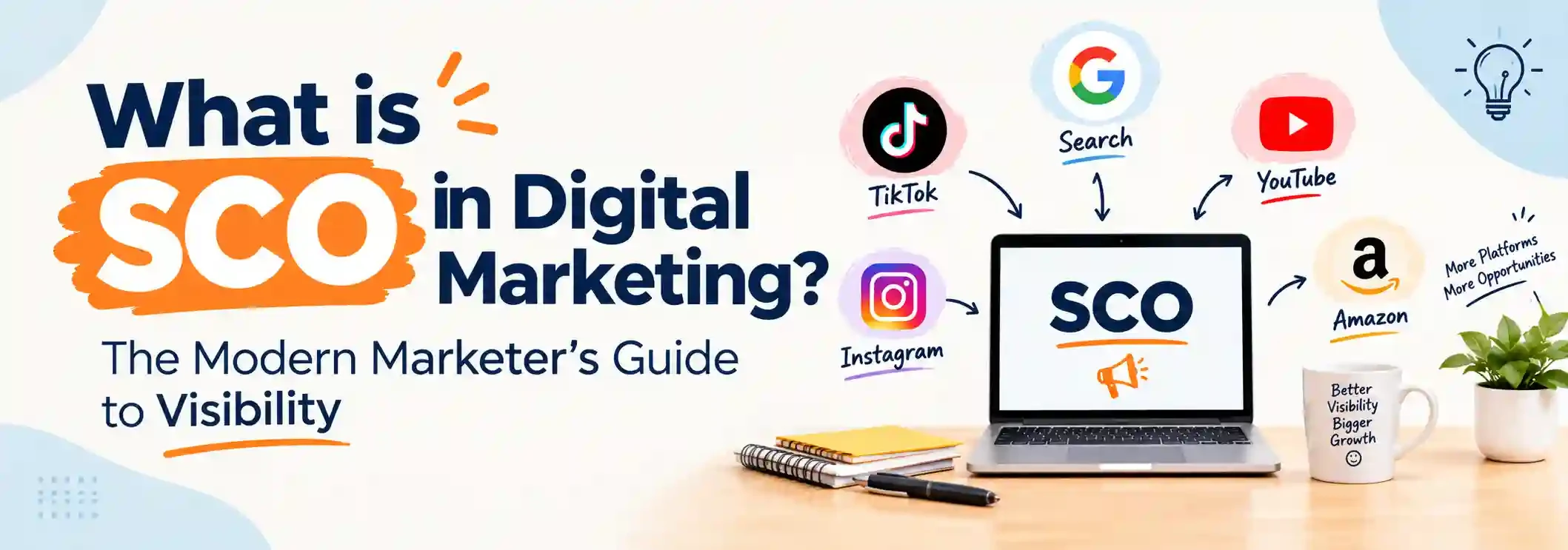
SCO (Search/Social Channel Optimization) is the practice of optimising your content, profiles and engagement so people can find your brand through the native search and recommendation systems of each platform, from TikTok and YouTube to Instagram and Amazon, not only through Google.
A note on terminology: SCO is an emerging label, and you will see overlapping terms such as social SEO and search everywhere optimization. The principle is the same. Meet customers where they search.
Traditional SEO focuses on ranking web pages in Google and Bing, driven by relevance, backlinks and technical health. SCO focuses on being discovered inside each platform, where recency, watch time, shares and community response often matter more than links. SEO asks, "Will my page rank?" SCO asks, "Will my content surface in this feed, this search bar and this shopping results page?"
Every platform has its own search engine, and each rewards different signals. Start by mapping where your audience looks for answers.
Use each platform's search bar and autocomplete suggestions as free keyword research. Whatever it suggests is what real users are typing.
Your profile is a landing page. Many users check it within seconds of finding your content.
Match the format to the platform instead of reposting the same asset everywhere.
Engagement signals such as saves, shares, comments and watch time tell algorithms your content is worth showing to more people.
Social listening shows what your audience is actually talking about, and hashtags help platforms categorise your content.
SEO leans heavily on backlinks, content quality and technical health. SCO platforms often weight recency and engagement, such as likes, shares, watch time and completion rate, alongside relevance. A new account with a standout video can outperform an established brand in a single day.
Video, images, audio and text overlays dominate. Your content must be understood by humans in seconds and by algorithms through captions, transcripts, alt text and metadata.
Trends can rise and fade within days. SCO rewards teams that can spot a trend early, respond quickly and keep a flexible content calendar.
Communities decide what spreads. Replying to comments, running challenges, featuring customer reviews and encouraging user-generated content (UGC) build trust and send positive signals. Authentic voices often outperform polished brand messaging.
| Feature | Traditional SEO | SCO (Search/Social Channel Optimization) |
|---|---|---|
| Primary targets | Google, Bing and other web search engines | TikTok, YouTube, Instagram, Amazon, Pinterest, Reddit and other platform search |
| Ranking signals | Backlinks, content relevance and quality, technical health, page experience | Engagement (watch time, shares, saves, comments), recency, metadata relevance, account activity |
| Core tactics | Keyword research, on-page optimization, link building, site speed, schema | Native keyword use in captions and titles, profile optimization, platform-specific formats, hashtags, community engagement |
| Main goals | Organic website traffic, rankings and conversions on your own site | Discovery, brand awareness, community growth and conversions inside or from the platform |
No. They work best together. Google remains the most trusted destination for information, while social platforms inspire discovery. A well-optimised YouTube video can appear in Google results, and a strong brand presence on social can boost branded searches. Think of SCO as extending your SEO footprint to every place customers look.
Search behaviour is spreading across platforms, and AI tools are adding another layer. Brands that rely on a single channel risk becoming invisible where their audiences spend time. SCO future-proofs your visibility by making your brand discoverable, consistent and engaging wherever intent begins.
Is SCO replacing SEO?
No. SCO extends SEO to platform search, and the two work best together.
Which platform should I start with?
Start where your audience already searches, usually the platform where your current content gets the most engagement.
How long does SCO take to show results?
Platform algorithms respond faster than Google, so many marketers can see early signals within weeks, though consistent publishing is essential.
