•
•
•
•
•
•
•

India’s new UPI monetisation model introduces MDR on select high-value merchant payments, creating both new costs for businesses and a potentially more sustainable future for the country’s digital payment infrastructure.
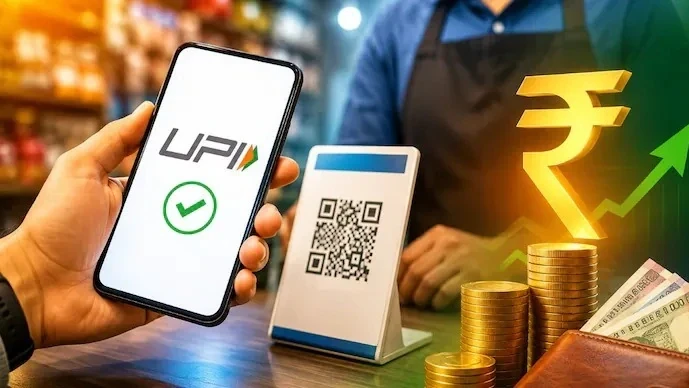
For years, one of UPI's biggest attractions has been its simple proposition: fast, convenient and effectively free digital payments.
That model is changing for a limited segment of merchant transactions.
Under the new framework announced by the Department of Financial Services, eligible Person-to-Merchant (P2M) UPI transactions above ₹2,000 will attract a standard MDR of 0.4% from October 15, 2026. For eligible transactions of ₹75,000 or more, the MDR is capped at ₹300.
The important distinction is that MDR is a merchant-side payment-processing charge, not a UPI tax paid directly by the customer.
A customer paying ₹10,000 through UPI is still expected to pay ₹10,000. The merchant, rather than the customer, bears the applicable MDR.
The government says the new framework is designed to support the financial sustainability of the UPI ecosystem while keeping ordinary consumer payments accessible.
For most people, not directly.
Person-to-person UPI transfers remain free, while merchant payments of up to ₹2,000 remain outside the standard MDR structure. The government says approximately 96% of merchant UPI transactions will remain unaffected.
That means a person buying groceries for ₹800, paying ₹1,500 at a restaurant or transferring ₹10,000 to a family member should not suddenly see a separate UPI charge simply because the payment exceeds some general threshold.
The impact becomes more relevant when a customer makes a larger purchase from an eligible merchant.
For example:
| Purchase | Standard 0.4% MDR |
|---|---|
| ₹2,000 | ₹0 |
| ₹3,000 | ₹12 |
| ₹5,000 | ₹20 |
| ₹10,000 | ₹40 |
| ₹25,000 | ₹100 |
| ₹50,000 | ₹200 |
| ₹75,000 | ₹300 |
| ₹1,00,000 | ₹300 cap |
These amounts illustrate the merchant-side cost, not an additional amount that customers are supposed to pay at checkout.
Although consumers are not directly charged MDR, that does not necessarily mean they will experience zero effects.
The biggest potential issue is payment-choice friction.
Imagine a customer purchasing a ₹60,000 television. The customer may want to scan a QR code and complete the transaction instantly. But the retailer now has to account for an MDR of up to ₹240 under the standard rate.
The merchant cannot simply add a UPI surcharge to the customer's bill under the announced framework. However, a business could reconsider which payment methods it encourages for large transactions.
Industry observers have warned that some merchants could respond by encouraging cash, bank transfers or cards for high-value purchases. Such behaviour could reduce some of the convenience that made UPI particularly attractive for large retail transactions.
This creates a potentially unusual situation:
The customer still gets free UPI, but the merchant may become more selective about accepting or promoting it for expensive purchases.
For merchants, the issue is straightforward: payment processing becomes another operating cost.
A 0.4% fee may look small in isolation.
But businesses rarely process just one transaction.
Consider a retailer processing ₹50 lakh of eligible UPI sales in a month. At 0.4%, the theoretical MDR before applicable caps and transaction-level details would be ₹20,000.
For a business operating on thin margins, that can become meaningful.
This is particularly relevant to sectors such as:
The impact will depend heavily on the merchant's transaction mix, margins, monthly UPI collections and applicable classification.
One of the most important parts of the framework is its treatment of smaller merchants.
The government has said eligible small merchants under the specified framework, including those with monthly QR collections up to ₹1 lakh, continue to receive zero-MDR treatment.
This means a neighbourhood shop, street vendor or small service provider that primarily handles low-value transactions may see little change.
For such businesses, UPI can remain what it has always been:
A low-friction way to accept digital payments without requiring expensive card infrastructure.
This is particularly important for India's large informal and micro-business ecosystem.
The picture changes for businesses where customers frequently spend thousands or tens of thousands of rupees in a single transaction.
Take an electronics store.
A customer purchasing a smartphone for ₹40,000 could generate an MDR of approximately ₹160 at the standard 0.4% rate.
A ₹70,000 purchase could generate approximately ₹280.
At ₹75,000 and above, the standard transaction-level charge reaches the ₹300 cap.
For retailers selling hundreds of high-value products each month, these amounts can accumulate.
The question for businesses therefore becomes:
Is the convenience and conversion rate of UPI worth the payment-processing cost?
For many businesses, the answer may depend on their profit margins and customer behaviour.
This is one of the biggest concerns surrounding the change.
India has spent years building a digital-payment culture around UPI. QR codes have become commonplace at shops, restaurants, taxis, service providers and markets.
If merchants begin discouraging UPI for larger purchases, customers could once again encounter situations where they need to carry cash or use alternative payment methods.
The New Indian Express reported concerns that the new structure could encourage some merchants to favour cash or other payment channels for affected transactions.
However, this outcome is not inevitable.
UPI still offers major advantages: instant settlement, widespread smartphone adoption, simple QR payments and strong consumer familiarity.
For many businesses, absorbing a small MDR may be preferable to creating checkout friction or losing a sale.
There is also a broader argument behind the policy.
Running a nationwide payment network requires substantial investment in:
The Department of Financial Services has presented MDR as part of a move toward a more sustainable financial model for the payments ecosystem.
Industry analysis has also pointed to a funding gap in the previous zero-MDR model, with government incentives covering only part of the industry's operating costs.
The government's position is therefore that monetising a limited portion of high-value merchant payments can help support the infrastructure behind India's enormous UPI network without charging ordinary consumers.
There is a potential upside if MDR revenue is used effectively.
A sustainable revenue model could provide payment companies, banks and technology providers with greater resources for:
As digital payments grow, fraud prevention becomes increasingly important.
Artificial intelligence and automated systems can help identify suspicious payment patterns.
A payment network handling enormous transaction volumes needs constant investment in capacity and resilience.
Payment companies could have greater incentives to develop new merchant tools, analytics and financial services.
The government's official explanation specifically links the revenue model with areas such as cybersecurity, fraud prevention and infrastructure.
So the debate is not simply:
“UPI becomes expensive.”
It is also:
“Can limited monetisation make UPI financially stronger without damaging its accessibility?”
For merchants, the smartest response is not necessarily to stop accepting UPI.
Instead, businesses can start measuring their actual exposure.
Separate transactions below and above ₹2,000.
Not every business and transaction is treated identically under the MDR framework.
Do not judge the policy based on a single ₹10,000 transaction. Look at your total monthly eligible transaction value.
A 0.4% payment cost may be insignificant for some businesses and material for others.
Businesses should follow the applicable rules rather than simply adding an unexplained "UPI charge" to customer bills.
Businesses should ensure their billing and accounting systems can reconcile MDR and applicable GST treatment correctly.
For consumers, there is little reason to abandon UPI simply because of the new MDR.
The important thing is understanding the difference between:
UPI charge to customer ≠ merchant MDR
If a merchant attempts to impose a separate UPI surcharge, customers should ask for clarification and check the applicable rules.
For everyday payments under ₹2,000, the new standard MDR should not affect the customer directly.
For expensive purchases, customers may simply notice that some merchants offer or encourage alternative payment methods.
The most interesting consequence of UPI monetisation may not be the actual amount of money involved.
It could be the change in payment behaviour.
For years, consumers have been trained to think:
Scan QR → Pay → Done.
The new model introduces a cost consideration on the merchant side.
That could encourage businesses to compare UPI with cards, bank transfers and cash more actively.
At the same time, merchants must consider the value UPI brings through convenience, faster checkout and potentially higher conversion rates.
A retailer might decide that paying ₹40 on a ₹10,000 sale is worthwhile if refusing UPI creates enough friction to lose the customer.
Another merchant with extremely thin margins may reach a different commercial conclusion.
The new MDR framework can therefore be viewed from two different perspectives.
For merchants handling high-value transactions, it introduces a new operating expense.
For the broader payment ecosystem, it creates a potential revenue mechanism for maintaining infrastructure and innovation.
For consumers, the immediate financial impact is limited because P2P transactions remain free and most merchant transactions remain outside the MDR framework.
The real test will come after implementation.
If businesses continue accepting UPI widely and the revenue contributes to stronger payment infrastructure, the transition could become relatively smooth.
If high-value merchants begin restricting UPI, customers could experience more friction and a gradual return to alternative payment methods.
India's UPI story is moving from growth at any cost toward questions of long-term sustainability.
The 0.4% MDR does not mean Indians will suddenly have to pay for every UPI transaction. The immediate impact is concentrated on selected merchant payments above ₹2,000, with exemptions and special rates covering different categories.
For customers, everyday UPI remains largely unchanged.
For small merchants, the impact may also be limited.
For high-value retailers, however, the new fee could become a meaningful cost that needs to be included in pricing and payment strategy.
The success of UPI monetisation will ultimately depend on whether the system can generate sustainable revenue without weakening the convenience, openness and widespread merchant acceptance that made UPI one of India's most important digital-payment platforms.
Not directly under the announced MDR framework. The 0.4% charge applies to eligible merchant transactions, while P2P UPI payments remain free.
No. The framework applies to specified eligible P2M transactions. There are exemptions and separate rates for certain categories.
Eligible small merchants meeting the specified criteria, including the ₹1 lakh monthly QR-collection threshold, remain under zero-MDR treatment.
The MDR is structured as a merchant-side payment charge, and merchants are not supposed to pass it directly to customers as a separate UPI charge.
The direct MDR is a merchant expense. Whether businesses change their prices or payment strategies is a separate commercial decision and could vary considerably by industry and profit margin.
The government has described the change as a way to create a more sustainable financial model for the payment ecosystem and support areas such as infrastructure, cybersecurity and fraud prevention.
That remains uncertain. The immediate framework affects a limited portion of merchant transactions, but merchant behaviour around high-value purchases will be important to watch after implementation.
Merchants should examine their monthly UPI turnover, percentage of transactions above ₹2,000, average transaction value, applicable merchant classification and effective MDR cost.
No. MDR is a payment-processing charge within the payment ecosystem rather than a general consumer tax on UPI transfers.