•
•
•
•
•
•
•

Tracing the network of trade routes that connected East and West for centuries, and the ideas it still offers modern trade
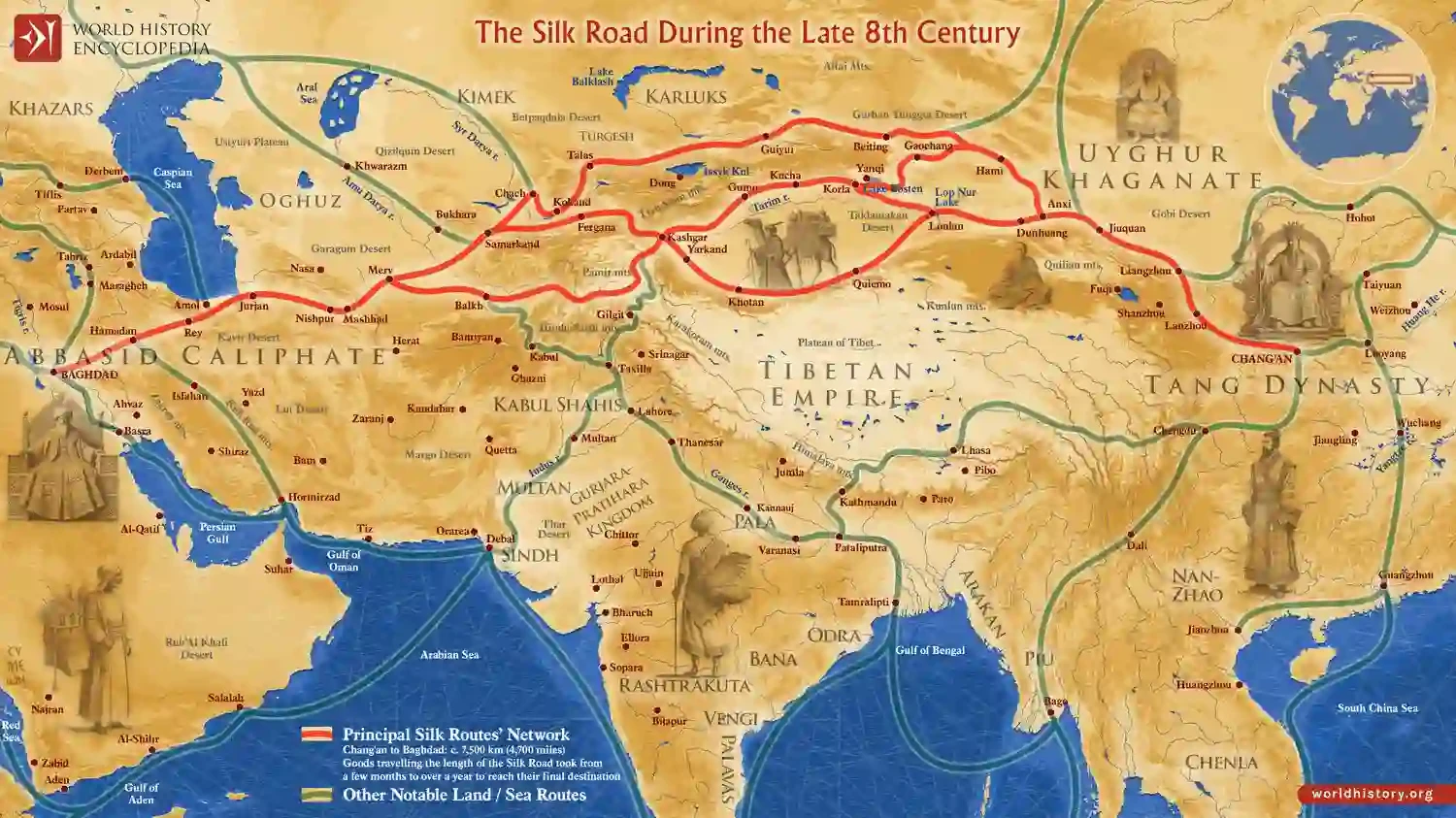
The Silk Road was not a single road but a vast, interconnected network of overland and maritime trade routes linking China to Central Asia, the Middle East, North Africa, and Europe over roughly a millennium and a half. The name itself was coined by a 19th-century German geographer, long after the network's most active periods, referring to the prized Chinese silk that traveled westward along these routes, though the network carried far more than fabric.
Caravans moved goods across deserts, mountain passes, and steppes, typically in stages, with goods changing hands between multiple merchants and intermediaries rather than a single trader traveling the entire route from end to end.
While silk gave the network its name, the routes carried an enormous variety of goods and ideas in both directions. Spices, precious stones, glassware, paper-making technology, and metalwork moved alongside religious texts, artistic styles, and scientific knowledge. Buddhism spread from South Asia into Central Asia and China partly along these trade routes, and later, Islam spread westward and eastward along similar paths. Papermaking technology, developed in China, gradually reached the Middle East and eventually Europe through this same network of contact.
The Silk Road was never controlled by a single empire or authority. Instead, it functioned through a patchwork of regional powers, city-states, and local rulers who taxed and protected trade passing through their territory in exchange for the economic benefits that commerce brought. Oasis cities and trading posts grew into wealthy, cosmopolitan centers precisely because of their position along these routes, often hosting merchants, religious travelers, and diplomats from many different cultures simultaneously.
Several factors contributed to the gradual decline of the overland Silk Road routes, including the rise of maritime trade routes that could move larger volumes of goods more efficiently by sea, political fragmentation and conflict along key overland routes, and the eventual development of direct sea trade connections between Europe and Asia that bypassed the traditional overland network entirely.
The Silk Road is frequently referenced in modern discussions of global trade and infrastructure, since it offers a historical example of how interconnected trade networks can transform regions economically and culturally over long periods. Modern infrastructure and trade initiatives connecting Asia, Europe, and Africa have explicitly drawn on Silk Road imagery and history when describing their goals, reflecting the enduring symbolic power of the ancient network.
Was the Silk Road a single physical road?
No. It was a network of multiple overland and maritime routes used by different traders at different times, rather than one continuous, fixed road.
Who controlled the Silk Road?
No single empire controlled the entire network. Various regional powers and city-states controlled different sections and taxed trade passing through their territory.
What besides silk was traded along these routes?
Spices, precious metals and stones, glassware, paper, religious texts, and various technologies and ideas moved along the network in both directions.
Why did the Silk Road decline?
The rise of more efficient maritime trade routes, along with political instability along overland paths, gradually reduced the importance of the traditional overland network.
The Silk Road's significance extends well beyond the silk that gave it its name, functioning as one of history's most important channels for the exchange of goods, religion, and knowledge between distant civilizations. Its legacy continues to shape how modern trade networks and infrastructure projects are conceived and described.