•
•
•
•
•
•
•

How the largest space telescope ever built is changing what astronomers know about the early universe, exoplanets, and star formation
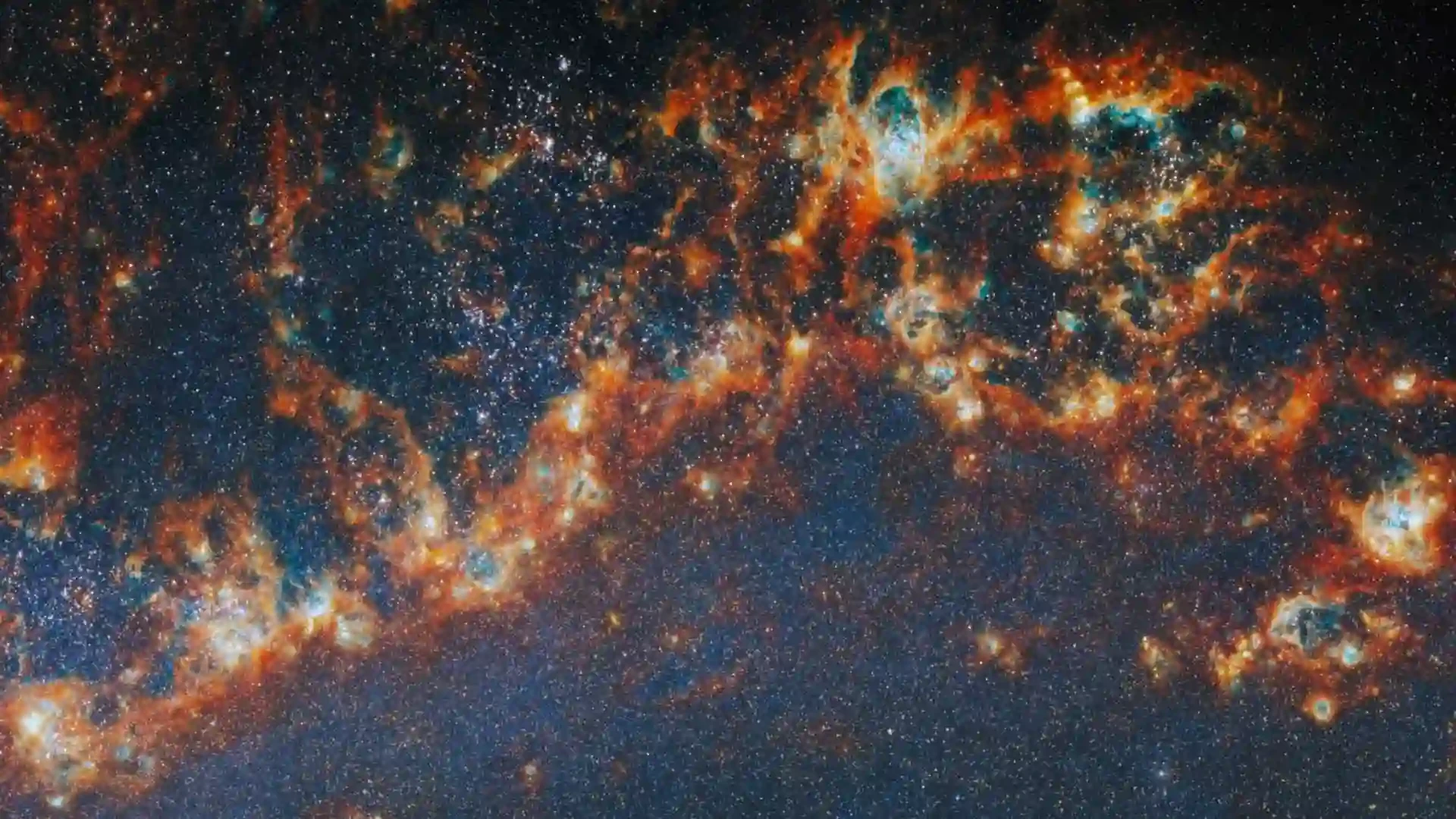
The James Webb Space Telescope has spent several years returning images and data that have forced astronomers to revise long-held assumptions about how galaxies, stars, and planetary systems form. As the largest and most powerful space telescope ever launched, JWST observes primarily in infrared light, letting it see further back in cosmic time and through cosmic dust that blocks visible-light telescopes like Hubble.
JWST launched on December 25, 2021, and reached its operational orbit around the Sun-Earth Lagrange point 2 (L2), roughly 1.5 million kilometers from Earth, in January 2022. It is a joint project of NASA, the European Space Agency (ESA), and the Canadian Space Agency (CSA).
| Instrument | Function |
|---|---|
| NIRCam | Near-infrared imaging, used for deep field images and early galaxy detection |
| NIRSpec | Near-infrared spectroscopy, analyzes chemical composition of distant objects and exoplanet atmospheres |
| MIRI | Mid-infrared imaging and spectroscopy, detects cooler objects like star-forming regions and dust |
| FGS/NIRISS | Fine guidance and additional imaging/spectroscopy, including exoplanet transit observations |
JWST has repeatedly identified galaxies from within the first few hundred million years after the Big Bang that appear more massive, more structured, and more mature than existing models of early galaxy formation predicted. Several candidate galaxies observed at redshifts corresponding to roughly 300–400 million years after the Big Bang have prompted astronomers to reconsider how quickly galaxies assembled stars and structure in the universe's infancy.
JWST's spectroscopic instruments have directly detected molecules in the atmospheres of exoplanets light-years away, including:
These observations move exoplanet science from inferring a planet's existence to directly characterizing what its atmosphere is made of.
JWST's infrared capability lets it peer through the dust clouds that obscure star-forming regions in visible light. It has produced detailed images of stellar nurseries such as the Pillars of Creation in the Eagle Nebula, revealing previously hidden protostars and structures within the dust columns, and has observed protoplanetary disks where planets are actively forming around young stars.
| Feature | Hubble Space Telescope | James Webb Space Telescope |
|---|---|---|
| Primary wavelength | Mostly visible and ultraviolet light | Primarily infrared |
| Mirror diameter | 2.4 meters | 6.5 meters |
| Orbit | Low Earth orbit (~540 km) | Sun-Earth L2 (~1.5 million km) |
| Launched | 1990 | 2021 |
| Cooling | Not deeply cooled | Actively shielded to extreme cold for infrared sensitivity |
| Serviceable by astronauts | Yes (serviced 5 times) | No — too far from Earth |
Because infrared light penetrates dust and is less affected by the redshift of extremely distant objects, JWST can observe galaxies and events that are effectively invisible to Hubble, while Hubble remains valuable for visible and ultraviolet observations JWST isn't designed to make. The two telescopes are complementary rather than direct replacements of one another.
As the universe expands, light from very distant objects gets stretched to longer wavelengths — a phenomenon called redshift. Light that started as visible or ultraviolet light from the earliest galaxies has been stretched into infrared wavelengths by the time it reaches us. A telescope built to see this shifted light needs infrared instruments and, critically, needs to be extremely cold itself, since a warm telescope would essentially glow with its own infrared "noise" and drown out the faint signals from deep space. This is why JWST operates far from Earth's warmth and uses a massive sunshield rather than sitting in low Earth orbit like Hubble.
JWST's findings matter beyond specialist astronomy circles because they touch fundamental questions:
JWST's mission is designed to last at least 20 years based on fuel reserves, considerably longer than its original planned lifetime, due to a highly precise launch that conserved propellant. Coming areas of focus include:
How far can the James Webb Space Telescope see?
JWST can observe light from galaxies formed within a few hundred million years of the Big Bang, roughly 13.5 billion years ago, making it capable of observing some of the earliest structures in the universe.
Why does JWST orbit so far from Earth?
Its L2 orbital position keeps the Sun, Earth, and Moon behind its sunshield at all times, allowing the telescope to stay extremely cold — essential for detecting faint infrared light without interference from its own heat.
Is JWST better than Hubble?
Not exactly better — they observe different wavelengths and serve complementary purposes. JWST specializes in infrared observations of distant, dusty, or extremely early objects, while Hubble remains strong for visible and ultraviolet astronomy.
Has JWST found signs of alien life?
No confirmed signs of life have been found. JWST has detected chemical signatures in exoplanet atmospheres, which is a foundational step toward eventually identifying potentially habitable conditions elsewhere, but it has not detected biosignatures confirming life.
How long will JWST keep operating?
Its precise launch trajectory conserved enough propellant to support science operations for at least 20 years, well beyond its original design target.
Since becoming operational, JWST has repeatedly produced results that challenge existing astronomical models, from unexpectedly mature early galaxies to detailed exoplanet atmospheric chemistry. Its combination of a large mirror, infrared instrumentation, and a stable, extremely cold observing position has made it one of the most productive scientific instruments in history, and its ongoing observations continue to reshape core questions in cosmology, planetary science, and the search for habitable worlds.