•
•
•
•
•
•
•

Inside one of the ancient world's largest and most enigmatic urban societies
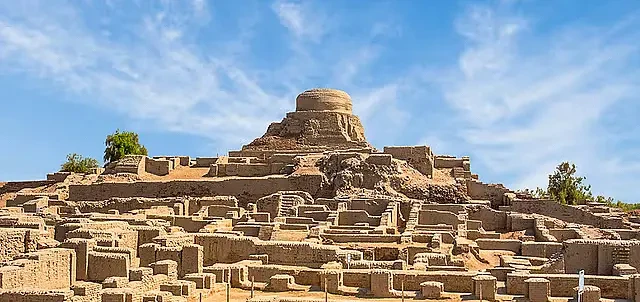
The Indus Valley Civilization emerged along the fertile floodplains of the Indus River and its tributaries, in a region spanning much of modern Pakistan and parts of northwest India. Its history is generally divided into three broad phases:
Two sites in particular define the popular image of the civilization: Mohenjo-daro and Harappa. Both were large urban centers built on strikingly similar plans, suggesting a shared architectural and administrative tradition despite being hundreds of kilometers apart.
| City | Modern Location | Notable Features |
|---|---|---|
| Mohenjo-daro | Sindh, Pakistan | Great Bath, granary, grid-planned streets |
| Harappa | Punjab, Pakistan | Citadel mound, granaries, cemetery evidence |
| Dholavira | Gujarat, India | Water reservoirs, signage, stadium-like structure |
| Lothal | Gujarat, India | Dockyard, bead-making workshops |
| Rakhigarhi | Haryana, India | One of the largest known Harappan settlements |
Indus cities are especially notable for their urban planning. Streets were often laid out in grid patterns, houses were built from standardized fired bricks, and many settlements had covered drainage systems — a level of civic infrastructure not matched elsewhere in the ancient world at the time.
The Harappans developed a highly standardized system of weights and measures, made from precisely cut stone cubes, which suggests centralized regulation of trade and commerce. Their economy relied on agriculture (wheat, barley, and cotton cultivation), craft production (bead-making, pottery, metalworking), and long-distance trade, with evidence of contact reaching as far as Mesopotamia, where Indus-style seals and beads have been found.
Distinctive stamp seals, often carved with animals such as bulls and unicorn-like figures alongside short inscriptions, are among the civilization's most recognizable artifacts. These seals likely served administrative or trade-related purposes.
One of the great unsolved puzzles of ancient history is the Indus script, a system of symbols found on seals, pottery, and small tablets. Despite decades of scholarly effort, the script has not been definitively deciphered, and debate continues over whether it represents a full writing system, a set of symbolic or religious markers, or something else entirely. Its resistance to decoding means much of Harappan political and religious life remains inferred rather than directly known.
The Mature Harappan phase gave way to gradual decline after around 1900 BCE. Proposed explanations include shifts in river courses, weakening of monsoon patterns, and broader climatic change affecting agriculture, rather than a single catastrophic event or invasion, as older theories once suggested. Populations appear to have dispersed into smaller regional communities across the subcontinent, with cultural continuities feeding into later South Asian traditions.
Though its script remains silent, the Indus Valley Civilization's contributions — sophisticated urban planning, standardized trade systems, and extensive regional networks — mark it as one of the most remarkable achievements of the ancient world.