•
•
•
•
•
•
•

A practical checklist for evaluating whether your content is structured to be found and cited by AI answer engines
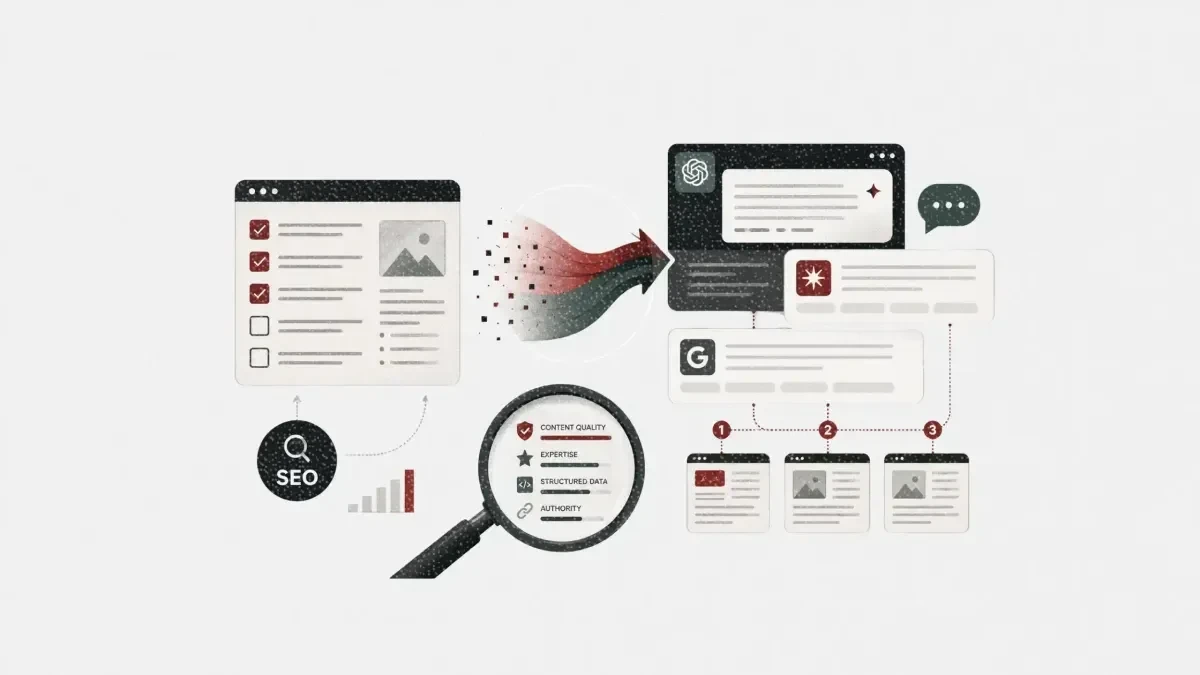
Traditional SEO audits focus on rankings in a list of blue links: title tags, backlinks, page speed, and keyword targeting. AI answer engines work differently. Rather than ranking ten links, they synthesize an answer from one or more sources and, in many cases, cite where that information came from. A page can rank reasonably well in traditional search while still being a poor candidate for AI citation, because the two systems reward somewhat different qualities. A GEO-focused content audit looks specifically at whether a page is easy for an AI system to extract a clear, accurate answer from.
AI systems tend to favor content that answers a specific question plainly, early, and without requiring the reader to piece together an answer from scattered context. For each important page, ask: if someone asked this page's core question directly, is there a single paragraph or sentence that answers it clearly? Pages that bury the answer under long introductions or require inference across multiple sections are harder for AI systems to extract confidently.
Headings, lists, and tables help both human readers and AI systems parse content quickly. During an audit, check whether:
AI systems weigh credibility signals when deciding what to cite. An audit should check whether claims are supported with clear attribution, whether statistics include their source and date, and whether the page distinguishes between established facts and opinion or speculation. Pages that state claims without any indication of where the information came from are less likely to be treated as trustworthy sources by AI summarization systems.
Pages that largely repeat what is already well covered elsewhere on the same site, or across the web generally, are less likely to be selected as a citation source, since AI systems often favor content that adds a distinct angle or level of detail. An audit should flag near-duplicate pages competing for the same core question and consider consolidating them.
| Audit Area | What to Check |
|---|---|
| Direct answers | Is the core question answered clearly and early? |
| Structure | Are headings, lists, and tables used appropriately? |
| Sourcing | Are claims and statistics attributed with dates? |
| Uniqueness | Does the page add distinct value versus existing coverage? |
| Technical access | Can crawlers and AI systems actually access and parse the page? |
Expect GEO auditing to become a more standardized part of regular content maintenance, similar to how technical SEO audits became routine practice over the past decade. As AI search features continue to expand, publishers who treat content structure and sourcing as an ongoing discipline, rather than a one-time cleanup, are likely to see more consistent visibility across both traditional and AI-powered search results.
Is a GEO audit different from a regular SEO audit?
They overlap significantly but focus on different priorities. A GEO audit emphasizes direct answerability, structural clarity, and sourcing credibility specifically for AI summarization, while a traditional SEO audit covers a broader set of ranking factors.
Do I need special tools to run a GEO audit?
No special tools are required to start. Much of the audit can be done manually by reviewing whether each key page answers its core question clearly and is well structured, though some SEO platforms now offer AI-visibility tracking features.
How often should a GEO audit be repeated?
Because AI search features continue to evolve, a periodic review, similar in frequency to a standard SEO content audit, is a reasonable approach rather than a one-time exercise.
Does better GEO structure hurt traditional SEO?
No. Clear structure, direct answers, and credible sourcing are generally beneficial for both traditional search rankings and AI citation likelihood.
A GEO content audit gives publishers a concrete way to evaluate readiness for an AI-driven search landscape rather than guessing at what AI systems might favor. Focusing on direct answers, clear structure, and credible sourcing addresses the core signals that matter across both traditional and AI-powered search.