•
•
•
•
•
•
•

Discover how farming, rivers, trade and growing settlements transformed human societies and gave rise to the world's earliest civilizations.
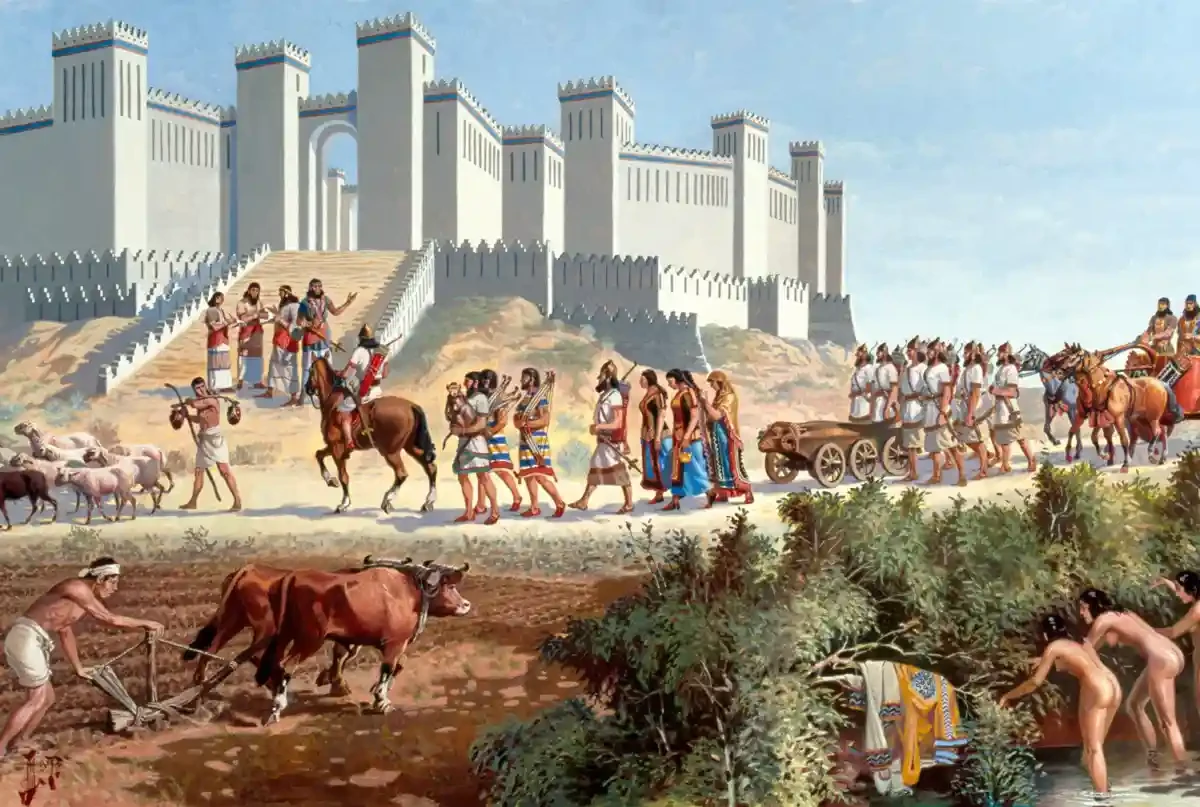
When people talk about the “birthplace of civilization,” Mesopotamia is often the first place that comes to mind.
Located between the Tigris and Euphrates rivers, roughly covering parts of modern-day Iraq, Syria and Türkiye, Mesopotamia became one of the earliest regions where villages developed into cities and increasingly complex societies.
But the story is more complicated than saying that civilization was “invented” in one location.
Civilization was the result of a long process that unfolded over thousands of years. Agriculture, permanent settlements, population growth, trade, administration, technology and social organization gradually transformed human communities.
Archaeological evidence shows that agriculture and the rise of civilizations occurred within the last roughly 12,000 years.
And several regions eventually developed complex civilizations independently.
So, rather than imagining civilization as a single invention that travelled from one place to another, it is better to think of human civilization as multiple interconnected experiments in organized living.
For most of human history, people did not live in cities.
Small groups of hunter-gatherers moved across landscapes in search of animals, plants, water and other resources. Their lives were highly adaptable, but they generally did not have the enormous permanent settlements associated with later civilizations.
Then something extraordinary began to happen.
Humans learned to cultivate plants and domesticate animals.
This transition did not happen everywhere at exactly the same time. Different communities domesticated different plants and animals in different parts of the world.
The change was enormous.
Once people could produce food rather than relying entirely on what they could find in the wild, some communities could remain in one place for longer periods.
According to the Smithsonian, the development of farming and herding transformed landscapes, while greater food availability helped populations grow. Villages expanded into towns and, eventually, cities.
This transformation is often associated with the Neolithic Revolution.
However, archaeologists now know that the process was not as simple as “humans discovered farming and immediately created cities.”
Some permanent settlements existed before agriculture became widespread. Archaeological evidence from sites in the eastern Mediterranean shows that people could establish relatively permanent communities while still relying heavily on hunting and gathering.
Civilization therefore emerged through a combination of changes rather than a single invention.
Many early civilizations developed around major rivers.
This was not a coincidence.
Rivers provided water, fertile soil, food, transportation and opportunities for trade.
Flooding could deposit nutrient-rich sediment on agricultural land. Rivers also provided drinking water and supported animals, fish and plants.
As farming became more productive, communities could produce food surpluses.
That surplus was crucial.
If everyone had to spend every hour producing food simply to survive, there would be little opportunity for specialized occupations.
But if farmers produced more food than their immediate families required, other members of society could become builders, potters, metalworkers, merchants, soldiers, administrators, priests or scribes.
This increasing division of labour was one of the foundations of complex society.
National Geographic describes civilization as a complex way of life involving urban settlements, communication systems, administration and division of labour. It also links the earliest civilizations to agricultural surpluses and trade.
Mesopotamia is particularly important because it witnessed some of the earliest developments associated with urban civilization.
Between the Tigris and Euphrates, agricultural settlements gradually grew larger.
The British Museum notes that Mesopotamia saw small agricultural settlements develop into large cities, supported by agriculture, writing, technology and trade.
Among the most important people in this story were the Sumerians, who lived in southern Mesopotamia.
They developed powerful city-states including Uruk, Ur and Girsu.
These cities were not simply large collections of houses.
They had temples, administrators, craftsmen, merchants, agricultural systems and increasingly sophisticated political structures.
The growth of cities created another problem:
How do you manage thousands of people, goods, land and resources?
One answer was writing.
One of civilization's most important developments was the emergence of writing.
In Mesopotamia, the Sumerians developed cuneiform, a writing system made by pressing a shaped stylus into clay.
Early writing was closely connected to practical needs such as administration, accounting and recording goods.
Over time, however, writing became much more than bookkeeping.
It was used for laws, literature, religious texts, correspondence, mathematics and historical records.
The British Museum identifies writing as one of the major achievements associated with ancient Mesopotamian civilization.
This changed human society permanently.
Information no longer had to exist only in people's memories.
It could be recorded, stored and passed to people who were not present when an event occurred.
That ability would become one of the defining characteristics of complex civilizations.
Although Mesopotamia is often described as one of civilization's earliest cradles, other regions developed sophisticated societies as well.
Among the major early centres were:
Historians commonly identify modern-day Iraq, Egypt, India/Pakistan, China, Peru and Mexico among the major regions where early civilizations emerged.
This is an important distinction.
Civilization was not simply a technology invented in Mesopotamia and exported to the rest of the world.
In several regions, people developed agriculture, cities, political systems, architecture, writing or other complex cultural traditions through their own historical processes.
One of the most famous early civilizations developed along the Nile River.
The annual rhythms of the Nile supported agriculture and helped sustain a large population.
Over time, Egypt developed centralized political authority, monumental architecture, writing, mathematics, religious institutions and an elaborate administrative system.
The pyramids are perhaps the most famous surviving symbol of this civilization, but they were only one part of a much larger society.
Egyptian civilization demonstrates the same broader pattern seen elsewhere:
reliable food production → population growth → settlements → specialization → administration → complex society.
Farther east, another major civilization emerged in the Indus River Valley, covering parts of modern-day Pakistan and northwestern India.
The Indus civilization is especially famous for cities such as Harappa and Mohenjo-daro.
These settlements featured carefully planned streets, drainage systems, buildings and evidence of extensive trade.
Agriculture in the region has very deep roots. Evidence of plant and animal domestication dates to around 7000 BCE in parts of the region, while the mature Indus Valley civilization developed much later.
The Indus civilization also maintained connections with neighbouring regions.
Archaeological evidence indicates contact with areas including Mesopotamia and Egypt, demonstrating that early civilizations were not isolated worlds.
In East Asia, complex societies developed along the Yellow River and other river systems.
Agriculture supported growing populations, while political institutions, craft production and eventually urban centres became increasingly sophisticated.
China's development followed its own distinctive path rather than simply copying Mesopotamia or Egypt.
This is one reason historians increasingly speak about multiple cradles of civilization.
Human societies repeatedly found ways to turn fertile landscapes into permanent communities.
Civilization spread through a combination of migration, trade, cultural exchange, conquest and independent development.
Trade was particularly important.
Once communities began producing specialized goods, they needed materials that were not available locally.
A city might have abundant agricultural products but lack metals, timber or valuable stones.
Trade networks connected distant communities.
Goods travelled.
So did ideas.
A merchant could carry not only objects but also knowledge about technologies, customs, artistic styles and agricultural practices.
Over generations, these exchanges could influence societies hundreds or even thousands of kilometres away.
People themselves moved.
Families, farmers, merchants, craftsmen and entire communities migrated in response to opportunities, environmental changes, conflict and population pressures.
When people moved, they carried their languages, technologies, religious traditions, crops and cultural practices with them.
This created cultural mixing.
Agricultural knowledge could also spread between neighbouring societies.
The history of the Indus region provides an interesting example. Evidence suggests that farming communities there had connections with regions to the west, while researchers continue to examine the balance between imported agricultural practices and independent development.
As states became larger and more powerful, another force became increasingly important:
empire.
Empires connected enormous territories under a single political system.
Roads, administrative systems, military campaigns and taxation networks could bring distant populations into closer contact.
Conquest could spread languages, political institutions and technologies, although it could also destroy communities and cultures.
The ancient Near East provides many examples.
The Assyrians, Babylonians, Persians and later empires controlled large territories and connected previously separate regions.
The British Museum notes that increasing international contact and trade influenced the material culture of the ancient Near East as political states and empires expanded.
The earliest civilizations began as relatively concentrated communities.
But over thousands of years, human societies became increasingly interconnected.
Trade routes expanded. Ships crossed seas. Caravans travelled across deserts. Merchants connected cities. Empires linked distant populations. Ideas moved alongside people and goods.
Eventually, these networks stretched across enormous parts of Eurasia, Africa and beyond.
The process was neither smooth nor inevitable.
Civilizations rose and fell. Cities were abandoned. Empires collapsed. Trade networks disappeared and later returned.
Yet knowledge often survived.
Writing systems preserved information. Craftspeople passed techniques from generation to generation. Agricultural traditions continued. Religious ideas evolved. Political institutions were adapted by later societies.
In this way, civilization became cumulative.
Each generation inherited part of the knowledge created by those before it.
The story of civilization is not simply the story of kings, pyramids or ancient cities.
At its heart, it is the story of human cooperation and organization.
People learned to produce food. They settled in communities. Communities grew into towns. Towns became cities. Cities required administration. Administration encouraged writing and record-keeping. Trade connected distant communities. Governments developed laws and institutions. Specialized occupations emerged.
And eventually, networks of cities and states created the foundations for the complex societies we recognize today.
The remarkable part is that this transformation happened in multiple parts of the world.
Mesopotamia may have been one of the earliest and most influential urban centres, but it was only one chapter in a much larger human story.
Today's cities, governments, universities, markets and communication networks are separated from the first settlements by thousands of years.
Yet some of the basic challenges remain surprisingly familiar.
How do we organize large populations? How do we distribute food and resources? How do we record information? How do we build infrastructure? How do we trade with people far away? How do we create rules for living together?
The first civilizations began developing answers to these questions on an ancient scale.
Their solutions were imperfect, and many disappeared.
But the experiment continued.
From the villages of early farmers to the cities of Mesopotamia, the Nile, the Indus and China, and eventually to interconnected societies across the globe, civilization has been an ongoing process rather than a single invention.
The birthplace of civilization, therefore, is not just one place on a map. It is a story of how humans learned to settle, cooperate, organize, exchange ideas and build societies larger than anything that had existed before.