•
•
•
•
•
•
•

Launched on 30 August 2026, Roman is heading to a point a million miles from Earth. Here is what it will do and why astronomers are excited.
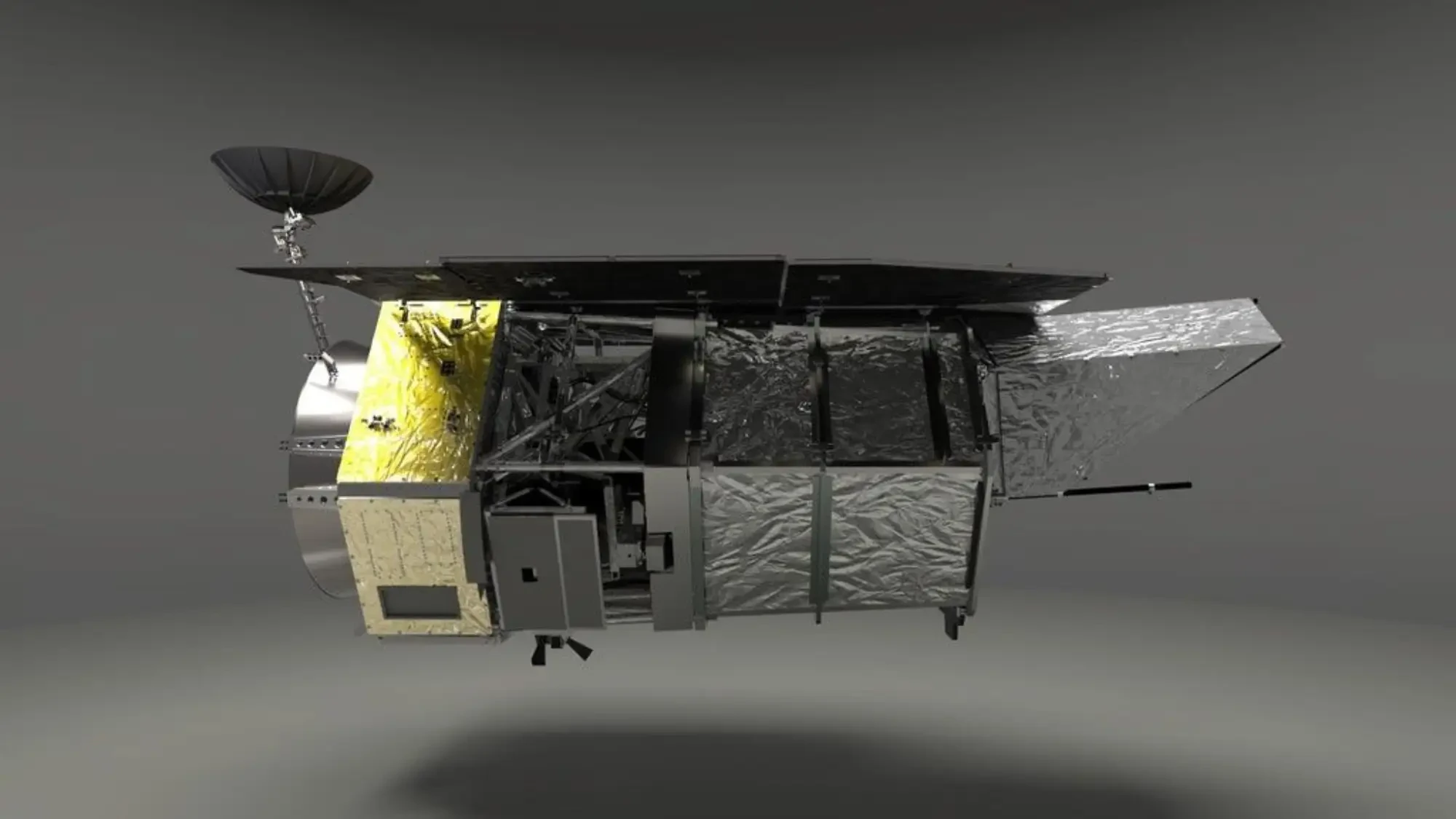
On 30 August 2026 at 7:26 a.m. EDT, a SpaceX Falcon Heavy lifted off from Launch Complex 39A at NASA's Kennedy Space Center carrying the Nancy Grace Roman Space Telescope. NASA Administrator Jared Isaacman said Roman would "give us a new atlas of the universe."
Roman is not designed to replace Hubble or Webb. It is designed to do something neither can: survey enormous areas of the sky in sharp infrared detail, very quickly.
Nancy Grace Roman was NASA's first chief of astronomy. She played a central role in making the Hubble Space Telescope a reality and is often called the "Mother of Hubble." Naming the telescope after her honours her role in building space astronomy.
L2 offers a stable, cold environment with an uninterrupted view of deep space.
A 300-megapixel infrared camera built from 18 detectors. Its field of view is roughly 100 times larger than Hubble's infrared camera, while keeping similar sharpness.
A technology demonstration that blocks starlight to reveal faint planets and dusty discs near bright stars. It tests techniques that future missions will need to image Earth-like planets.
The universe's expansion is speeding up, and scientists attribute this to a mysterious component called dark energy. Roman will study it by:
Roman will use gravitational microlensing, which occurs when a foreground star and planet bend the light of a background star. By watching dense star fields toward the centre of the Milky Way, Roman is expected to find thousands of exoplanets, including planets far from their stars and "rogue" planets drifting alone through space.
NASA says Roman can survey the sky about a thousand times faster than Hubble and will send back around 1.4 terabytes of data per day. All data are planned to be publicly available, giving astronomers worldwide — including in India — a huge new resource.
| Feature | Hubble | Webb | Roman |
|---|---|---|---|
| Launch | 1990 | 2021 | 2026 |
| Location | Low Earth orbit | Sun–Earth L2 | Sun–Earth L2 |
| Main light | Visible/UV/near-IR | Infrared | Near-infrared |
| Strength | Detailed imaging | Deepest, faintest objects | Wide, fast surveys |
Its primary mirror is the same size as Hubble's (2.4 metres), but its field of view is far larger.
NASA expects first images by early 2027, after travel to L2 and commissioning.
Its microlensing survey can detect small planets, and its coronagraph tests technology for future missions aimed at imaging Earth-like worlds.
NASA plans to make Roman data openly available to scientists and the public.
Roman will not produce a single iconic image as much as a map of the cosmos. By charting how the universe expanded and counting planets across the galaxy, it could help answer two of the biggest questions in science: what is the universe made of, and how common are worlds like ours?
Source: NASA news release on the Roman launch (August 2026).