•
•
•
•
•
•
•

Price, variants, mileage, boot space and how Mahindra's first CNG SUV compares with Nexon iCNG and Brezza CNG
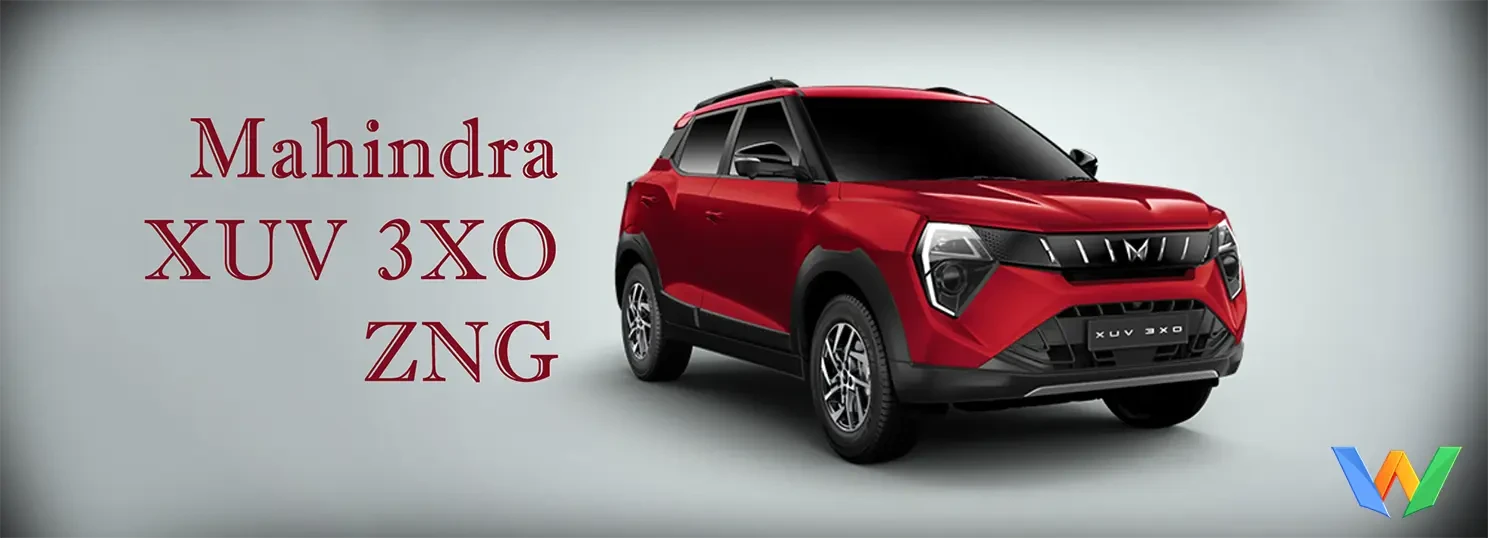
For years, Mahindra watched India's CNG boom from the sidelines. Now it has joined the party with a car that refuses to feel like a compromise. The Mahindra XUV 3XO ZNG puts a turbocharged engine, twin CNG cylinders and a full safety kit into one of India's most popular compact SUVs, arriving just as the XUV 3XO family crosses 5 lakh sales. This guide covers everything buyers need to know: price, variants, engine, mileage, boot space, how it compares with the Tata Nexon iCNG and Maruti Brezza CNG, and who should consider it.
CNG has quietly become one of the biggest growth stories in Indian motoring. According to industry data, CNG's share of passenger vehicle sales rose from 6.3 per cent in FY2020 to 19.5 per cent in FY2025. Tata Motors alone sold more than 2.03 lakh CNG vehicles in the 12 months to September 2026, about 27 per cent of its volumes.
The reasons are simple. CNG is usually cheaper per kilometre than petrol, and with higher petrol and diesel prices, buyers who drive long distances every day are looking for ways to cut running costs. Until now, Mahindra did not offer a CNG passenger car. The ZNG fills that gap.
The XUV 3XO ZNG is the CNG version of Mahindra's popular compact SUV, the XUV 3XO. It keeps the model's styling and feature set, adds a factory-fitted CNG system and arrives with a price starting at Rs 9.99 lakh (ex-showroom). Mahindra says it engineered the car for performance and driving dynamics, an area that has often been ignored on CNG vehicles, which typically trade power for economy.
The ZNG is offered in four variants, with ex-showroom pricing as follows:
| Variant | Price (ex-showroom) |
|---|---|
| MX Edge ZNG | Rs 9.99 lakh |
| REVX Edge (O) ZNG | Rs 10.79 lakh |
| AX5 ZNG | Rs 11.19 lakh |
| REVX A ZNG | Rs 12.27 lakh |
The price spread is about Rs 2.28 lakh from base to top. For comparison, the standard petrol and other XUV 3XO models are priced from Rs 7.79 lakh to Rs 15.04 lakh, so the CNG version commands a premium over the petrol base model. Ex-showroom prices exclude registration, insurance and other charges, so on-road prices will be higher.
The biggest talking point is the engine. Instead of a small, low-output unit, the ZNG uses Mahindra's 1.2-litre turbo-petrol engine with CNG capability, producing around 110 to 114 PS (reports quote slightly different rounding) and 200 Nm of torque. Mahindra says output stays essentially the same as the petrol version, which is unusual because CNG normally reduces power.
It uses a 10 bar CNG injection system. The practical benefit is stronger mid-range pull, better highway overtaking and less strain when the car is fully loaded. Buyers who have been put off by sluggish CNG cars will notice the difference.
Mahindra claims 24.7 km/kg, a figure measured under test conditions. Real-world mileage depends on:
A useful rule of thumb is to expect lower numbers on the road than the claimed figure. To estimate running costs, divide the local price of CNG per kilogram by your real-world kilometres per kilogram. As an illustration only, if CNG costs Rs 90 per kg and you achieve 20 km/kg, the fuel cost is about Rs 4.50 per kilometre. Local CNG prices vary, so check your area before calculating.
The classic problem with CNG cars is that the tank eats into the boot. The ZNG solves it with a twin-cylinder layout, two smaller tanks tucked under the boot floor. That preserves a flat loading floor and a 270-litre boot, which is workable for a weekend trip. The Tata Nexon iCNG, which also uses twin cylinders, offers a larger 321 litres, so Tata still has the edge on luggage space.
The XUV 3XO ZNG measures about 3,990 mm in length, 1,821 mm in width and 1,647 mm in height, with a 2,600 mm wheelbase. The Nexon iCNG is about the same length but narrower and shorter, with a wheelbase of 2,498 mm. A longer wheelbase and wider body generally help cabin space and stability, which is one of the XUV 3XO's strengths.
Six airbags and electronic stability control come standard across all four variants. That is a strong baseline for a car at this price, and it means buyers do not have to move to a higher trim to get the key safety features.
The launch comes just as the XUV 3XO family hits a major sales milestone. Domestic wholesales since February 2019, including the XUV300, the XUV 3XO launched in April 2024 and the XUV 3XO EV unveiled in January 2026, have totalled 505,590 units. The XUV 3XO itself has sold about 2.57 lakh units since its April 2024 launch. Mahindra is expected to see the CNG variants help the family reach roughly 1.25 lakh units in the 2027 financial year, which would be its best fiscal year yet, though this is a projection and not guaranteed.
| Feature | Mahindra XUV 3XO ZNG | Tata Nexon iCNG | Maruti Brezza CNG |
|---|---|---|---|
| Starting price (ex-showroom) | Rs 9.99 lakh | About Rs 8.30 to 8.35 lakh | About Rs 9.30 to 9.40 lakh |
| Engine | 1.2-litre turbo-petrol with CNG | 1.2-litre turbo-petrol with CNG | Naturally aspirated 1.5-litre with CNG |
| Power and torque (CNG) | About 110 to 114 PS, 200 Nm | 100 PS, 170 Nm | Lower than the turbo rivals |
| CNG cylinders | Twin, under boot floor | Twin, under boot floor | Check current spec |
| Boot space | 270 litres | 321 litres | Check current spec |
| Claimed mileage | 24.7 km/kg | About 24 km/kg | Check current spec |
| Strengths | Power, torque, safety, features | Lowest price, bigger boot, wide variant range | Simple, proven CNG |
Prices differ slightly between sources, so confirm with a dealer. The Nexon iCNG is the most affordable and has the largest boot. The XUV 3XO ZNG costs more but offers the strongest performance on paper. The Brezza CNG sits in between on price with a different, less powerful engine.
In my analysis, it suits:
It may suit you less if you want the lowest purchase price, in which case the Nexon iCNG starts cheaper, or if boot space is your top priority.
What is the price of the Mahindra XUV 3XO ZNG?
It starts at Rs 9.99 lakh and goes up to Rs 12.27 lakh, ex-showroom.
What is the claimed mileage?
24.7 km/kg.
How much boot space does it have?
270 litres.
Is it better than the Tata Nexon iCNG?
It offers more torque and standard six airbags, while the Nexon iCNG is cheaper and has a bigger boot. The best choice depends on your priorities.
When can I book it?
Bookings and deliveries open on October 20, 2026.
Does the CNG version lose power?
Mahindra says output stays essentially the same as the petrol turbo engine.
The XUV 3XO ZNG shows that CNG does not have to mean slow or cramped. With strong turbo power, twin cylinders, standard safety and Mahindra's popular SUV package, it is a serious new entry in one of India's fastest-growing car segments. Book a test drive, compare real-world figures and check your local CNG availability before you decide.
