•
•
•
•
•
•
•

With polls announced for 28 Legislative Council seats, here is a complete guide to India's upper houses at the state level.
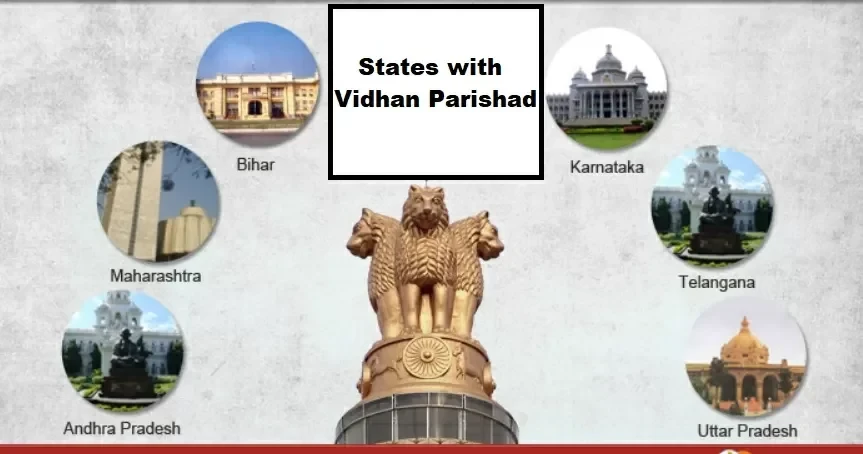
The Election Commission of India has announced polls for 28 Legislative Council seats in Uttar Pradesh, Bihar, Maharashtra and Karnataka, with voting on 23 October 2026. Unusually, these seats are not chosen by the general public — they are elected by graduates and teachers.
To understand why, you need to understand one of the least-known institutions in Indian democracy: the Legislative Council, or Vidhan Parishad.
A Legislative Council is the upper house of a state legislature. States with two houses are called bicameral; states with only a Legislative Assembly (Vidhan Sabha) are unicameral.
Think of it as a state-level version of the Rajya Sabha: a permanent house meant to bring in experience and review legislation.
Currently, six states have Legislative Councils:
Jammu and Kashmir's Legislative Council was abolished after the state's reorganisation in 2019.
Under Article 171, a Council's strength cannot exceed one-third of the state Assembly's membership, and must be at least 40 members.
Members are chosen as follows:
| Share | Elected or chosen by |
|---|---|
| About 1/3 | Members of local bodies (municipalities, district boards) |
| About 1/12 | Graduates of at least three years' standing residing in the state |
| About 1/12 | Teachers of at least three years' standing in secondary schools and above |
| About 1/3 | Members of the state Legislative Assembly |
| Remainder (about 1/6) | Nominated by the Governor from fields such as literature, science, art, cooperative movement and social service |
These are special constituencies with their own electoral rolls:
| State | Seats | Graduates' | Teachers' |
|---|---|---|---|
| Uttar Pradesh | 11 | 5 | 6 |
| Bihar | 8 | 4 | 4 |
| Maharashtra | 5 | 3 | 2 |
| Karnataka | 4 | 2 | 2 |
Key dates: notification 29 September; nominations close 6 October; polling 23 October; counting 27 October 2026.
The Council is weaker than the Assembly:
Arguments in favour:
Arguments against:
Several states have proposed creating or abolishing Councils over the years, but changes require an Act of Parliament.
Yes. A member of either house can be a minister or Chief Minister.
30 years.
Eligible graduates apply for inclusion in the graduates' electoral roll through the Election Commission's process for that constituency, usually using the prescribed form and proof of qualification.
Yes. Legislative Councils are a frequently tested topic in UPSC and state civil service exams under Indian polity.
Legislative Councils are a unique feature of Indian federalism — an upper house that gives a voice to graduates, teachers and local bodies. The upcoming polls in four states are a reminder that this lesser-known institution still plays an active part in state politics.
Sources: Constitution of India (Articles 168–171); Election Commission of India schedule as reported by India TV News (22 September 2026).