•
•
•
•
•
•
•

How solar manufacturing, the Green Hydrogen Mission, and grid upgrades are shaping India's path to its 2070 net-zero target
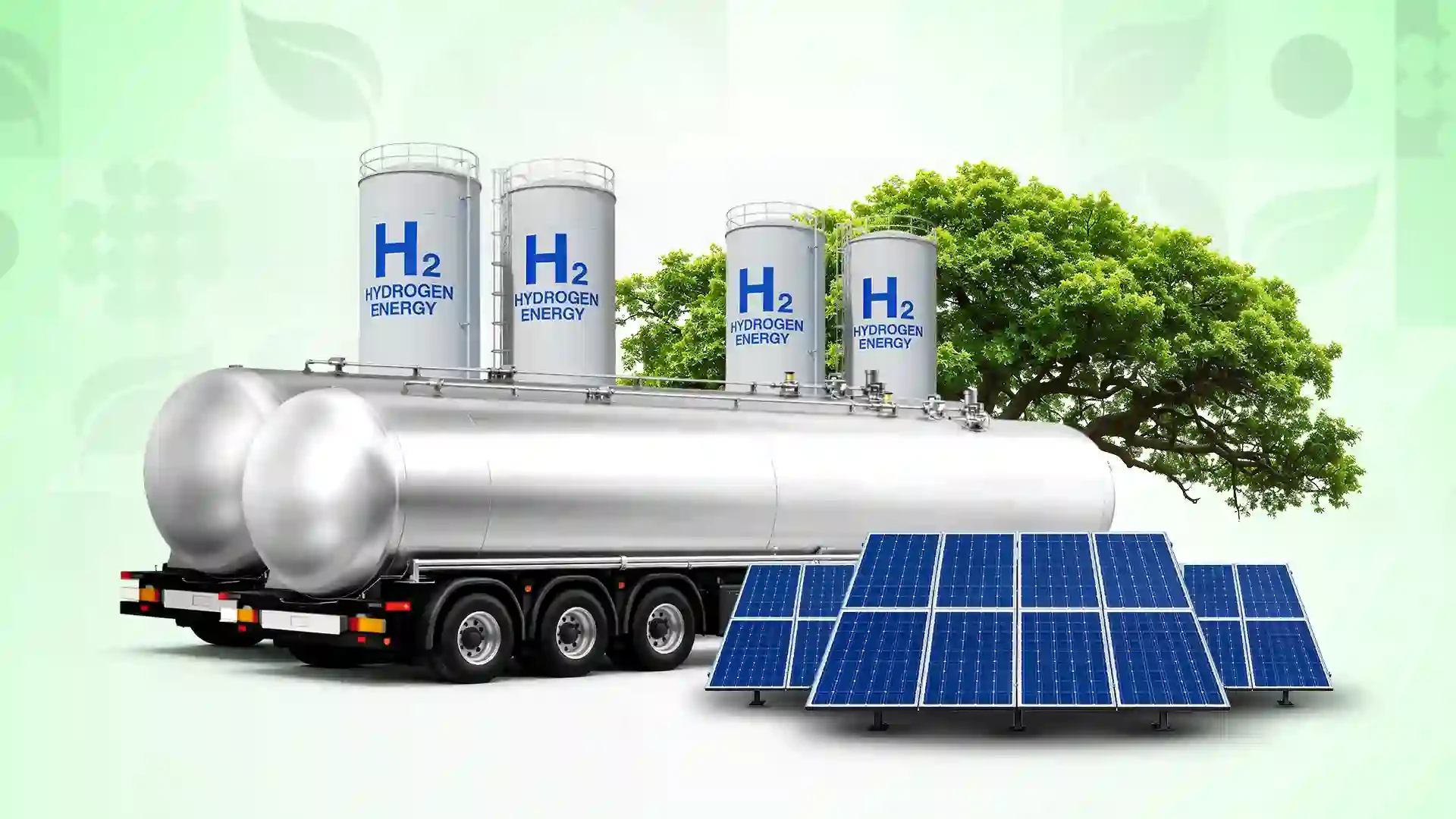
India has set itself one of the world's most ambitious energy transitions: rapidly scaling solar and wind capacity, building a domestic solar manufacturing base, launching a national green hydrogen programme, and doing all of it while electricity demand keeps rising with economic growth. The government has pledged to reach net zero carbon emissions by 2070, with a series of nearer-term interim targets meant to keep the country on track. This guide walks through where the transition stands, the policy tools driving it, and the practical obstacles — grid capacity and energy storage chief among them — that will determine how fast it actually moves.
At the COP26 climate summit in Glasgow in 2021, India announced a five-part climate pledge, often referred to as "Panchamrit":
These targets sit alongside India's earlier Nationally Determined Contributions under the Paris Agreement and give the renewable energy build-out a concrete set of near-term milestones rather than a distant, abstract 2070 date.
Solar has become the backbone of India's renewable capacity additions, helped along by falling module costs and large-scale auctioned solar parks. To reduce reliance on imported solar cells and modules — historically dominated by Chinese manufacturers — the government introduced Production-Linked Incentive (PLI) schemes for high-efficiency solar photovoltaic (PV) manufacturing.
Key elements of the PLI push:
The goal is to turn India from a net importer of solar equipment into a credible manufacturing hub, both to support the "Make in India" industrial agenda and to reduce exposure to global supply-chain disruptions.
Launched in January 2023, the National Green Hydrogen Mission aims to position India as a global hub for producing, using, and exporting green hydrogen — hydrogen produced by electrolysis powered by renewable electricity, as opposed to hydrogen made from fossil fuels.
| Mission Element | Target / Focus |
|---|---|
| Annual green hydrogen production | 5 million tonnes per annum (MMTPA) by 2030 |
| Associated renewable capacity | Roughly 125 GW of additional renewable capacity to power electrolysis |
| Investment ambition | Government and private-sector investment running into several lakh crore rupees |
| Early priority sectors | Refining, fertiliser production, steel, and heavy-duty transport |
Progress has been incremental rather than dramatic: government data has tracked green hydrogen production capacity being commissioned in stages, with several thousand tonnes-per-annum of capacity operational by early 2026 against the much larger 2030 goal. Analysts generally describe the mission as still in its early industrial-scale-up phase, with electrolyser manufacturing capacity, demand-side offtake agreements, and cost competitiveness against grey (fossil-based) hydrogen all needing to mature further.
Adding renewable capacity is only half the challenge; integrating it reliably into the grid is the other. Solar and wind are variable sources — solar generation drops to zero at night and wind output fluctuates with weather — which creates several technical and financial challenges:
Government responses have included dedicated viability-gap funding for battery storage projects, competitive bidding for "round-the-clock" renewable-plus-storage power, and continued expansion of interstate transmission infrastructure under schemes like the Green Energy Corridors.
India is simultaneously one of the world's largest emitters in absolute terms and a country whose per-capita emissions remain well below the global average, with hundreds of millions of people still climbing toward higher energy consumption as incomes rise. How India balances continued economic and energy-access growth against its climate commitments is consequential not just domestically but globally — decisions made in Indian energy policy over the next decade will materially affect whether global climate targets are within reach.
For India specifically, the renewable build-out also carries direct economic stakes: reducing costly fossil-fuel imports, building a domestic manufacturing and export industry around solar and green hydrogen, and insulating the economy from volatile global oil and gas prices.
India's power system has historically been dominated by coal, which still supplies the largest single share of electricity generation and remains central to grid reliability, particularly during periods of peak demand or low renewable output. The renewable transition is therefore better understood as a long, managed diversification rather than a rapid substitution — coal capacity continues to be added in the near term even as renewable capacity grows faster, with the expectation that coal's share of the generation mix declines gradually over subsequent decades.
Several developments will shape the next phase of India's energy transition:
What does "net zero by 2070" actually mean for India?
It means India has committed to reaching a state where any greenhouse gases it emits are balanced by an equivalent amount removed from the atmosphere, by the year 2070 — a later target date than several developed economies, reflecting India's developing-economy status and continuing growth in energy demand.
Is green hydrogen the same as regular hydrogen?
Chemically, yes — hydrogen is hydrogen. The "green" designation refers to how it is produced: via electrolysis powered by renewable electricity, rather than from natural gas (grey hydrogen) or from natural gas with carbon capture (blue hydrogen).
Why is India building its own solar manufacturing instead of just importing panels?
Domestic manufacturing reduces dependence on imports (predominantly from China), supports local jobs and industrial capacity, and reduces exposure to global supply-chain disruptions, though it can initially raise costs compared to buying the cheapest imported equipment.
Is coal power being phased out in India?
Not in the near term. Coal remains central to grid reliability and continues to see some capacity additions even as renewable capacity grows faster; the broader expectation among energy planners is a gradual decline in coal's share of the generation mix over subsequent decades rather than an abrupt phase-out.
India's renewable energy transition is advancing on multiple fronts at once — record solar and wind capacity additions, a nascent but growing domestic solar manufacturing base, and an ambitious green hydrogen programme still in its early industrial phase. The interim 2030 targets set at COP26 give the transition concrete near-term benchmarks, but grid integration, storage costs, and discom financial health remain the practical constraints that will determine how quickly the country can convert installed renewable capacity into reliable, round-the-clock clean power on the way to its 2070 net-zero commitment.