•
•
•
•
•
•
•

Geofencing connects a user’s physical location with digital services, helping websites and apps deliver more relevant local search results, recommendations, alerts and information.
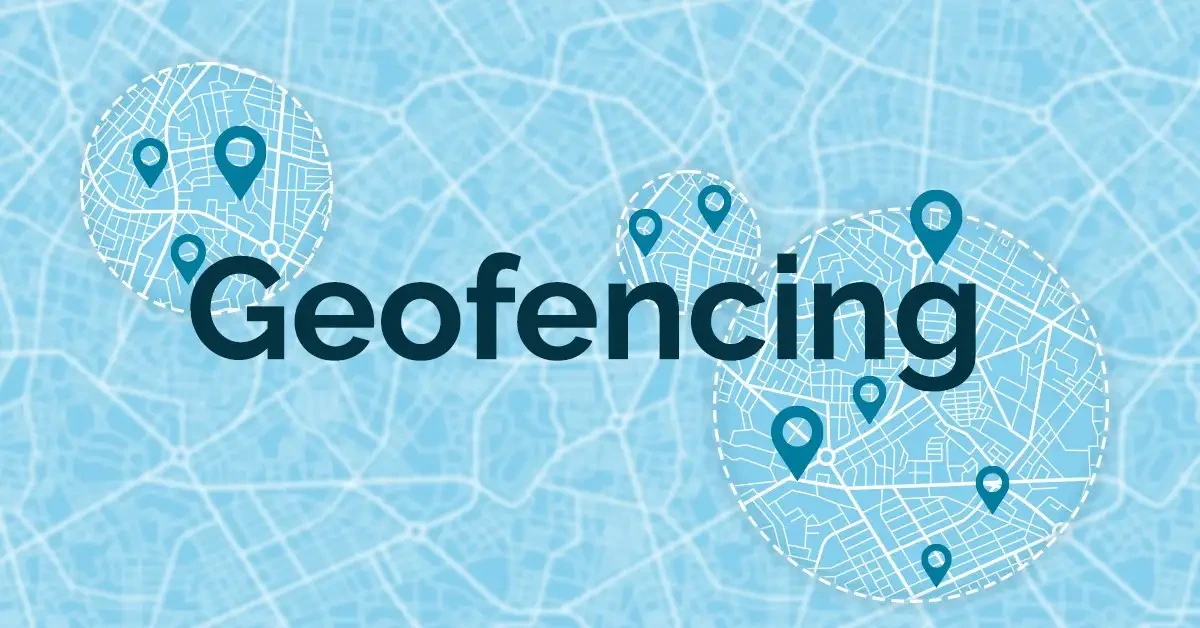
Geofencing is a technology that creates a virtual geographical boundary around a physical location. The boundary can be a simple circle around a point or a more complex polygon covering a particular area.
When a device enters or leaves the defined area, software can detect the event and trigger a predefined action. These actions may include sending a notification, displaying location-specific information, updating an application, recording an event or changing the content presented to the user.
For example, imagine someone walking through a shopping district. An application could recognize that the person has entered a predefined area and provide information about nearby stores, restaurants, events or services.
This is where geofencing becomes particularly interesting for internet search and local discovery.
Traditional internet searches are primarily based on what a person types. If someone searches for "restaurants", the search engine has to determine which restaurants might be relevant.
Location adds another important piece of information.
A search for "restaurants near me" is different from simply searching for "restaurants." A location-aware service can use the user's geographical position to find businesses within a particular area and then rank or filter the available results.
Google's mapping tools, for example, support nearby searches that can be restricted to geographical areas and can rank results using factors such as distance or popularity.
Geofencing can complement this process by defining specific areas of interest.
One of the biggest advantages is relevance.
Suppose a user enters a shopping mall surrounded by dozens of businesses. A shopping or discovery application could use the mall as a geofenced area and prioritize businesses, offers, services or information located inside or immediately around it.
Instead of searching the entire city, the application can concentrate on the geographical area that matters to the user.
This concept is particularly useful for:
Google's local discovery architecture demonstrates a similar principle: a location can be used as the starting point for finding nearby points of interest, displaying information such as addresses, opening hours, reviews and travel distances.
Imagine searching for "coffee shop" while travelling.
A search engine or application doesn't necessarily need to show coffee shops from an entire country. Location-aware search can narrow the discovery area to the user's surroundings.
Geofencing can make this even more contextual.
For example:
User enters airport geofence → airport services become more relevant.
User enters shopping-mall geofence → stores, restaurants and promotions may become more relevant.
User enters university campus geofence → campus facilities and nearby services can be prioritized.
User enters a tourist attraction geofence → nearby attractions, restaurants and travel information can become more useful.
The technology therefore creates a bridge between physical movement and digital information.
Location is already an important component of local search.
A location-aware application can obtain coordinates through device location services, while some geolocation systems can estimate a device's position using Wi-Fi access points, cellular information and, where applicable, IP-based information. Accuracy can vary significantly depending on the available signals.
Once a location is available, a service can search within a defined radius or geographical region.
For example:
Search: "Pharmacy near me"
The system can identify the user's approximate location and search for pharmacies within a relevant area.
A geofence adds another layer: instead of simply asking how far away a place is, an application can determine whether the user is inside a particular predefined area.
This can be useful for applications that need contextual information rather than just distance-based results.
Traditional search is usually user-driven.
The user types something → the search engine returns results.
Geofencing introduces an event-driven model.
The user enters an area → the application detects the event → relevant information or an action can be triggered.
Google's geofencing documentation describes this approach as detecting when a device crosses a virtual geographic boundary and then allowing the application or backend to respond to that event.
For example, a travel application could recognize that a traveller has entered a predefined tourist zone and surface information about attractions, transportation or nearby services.
The user doesn't necessarily have to repeatedly search for every piece of information.
Businesses can also use geographical boundaries to connect their physical locations with digital experiences.
Consider a restaurant with a geofence around its location.
When an eligible user enters the area, an application could potentially provide:
This doesn't mean that geofencing itself is a search engine. Instead, it provides location context that other digital services can use to make search and discovery more relevant.
Google's location-targeting documentation similarly describes geographical targeting as a way for businesses to reach people in particular areas and connect advertising with local customers.
These terms are often confused, but they perform different jobs.
| Technology | Main Purpose |
|---|---|
| Geolocation | Determines or estimates where a device is |
| Geofencing | Creates a virtual boundary and responds to entry/exit events |
| Geo-targeting | Uses location to target content, services or advertising |
| Geo-blocking | Restricts access to online content based on presumed location |
For example, geolocation might determine that a device is near a particular city. A geofence can then determine whether that device has entered a predefined zone. A website or application can use that information to provide a location-specific experience.
Geo-blocking is different because its primary purpose is restricting access based on location rather than improving local discovery.
A typical location-aware application may follow a process like this:
1. Determine location
The application obtains an approximate device location through available location technologies.
2. Define the geographical area
Developers create a virtual boundary around a location using a circle or polygon.
3. Monitor movement
The application or backend evaluates location updates against the defined boundary.
4. Detect an event
The system determines whether the device entered, exited or remained within the area.
5. Trigger an action
The application can then retrieve information, send a notification, update the interface or initiate another predefined workflow.
This architecture can also be combined with APIs for maps, places, directions and search. Google's mapping documentation, for example, shows how location search can be combined with nearby places, directions and place information to build local discovery experiences.
The usefulness of location-aware search also creates an important privacy consideration.
Location data can reveal where a device is and, depending on how it is collected and stored, can provide information about a person's movements.
For that reason, applications should clearly explain why location access is needed and provide appropriate controls for users. Developers should also minimize unnecessary collection and retention of location information and follow applicable privacy and data-protection requirements.
Importantly, geofencing does not automatically mean an application knows a person's exact location at all times. The accuracy of location information depends on the technology and signals being used. For example, Google's geolocation documentation notes that Wi-Fi and cellular-based positioning can have different accuracy ranges, while IP-based estimates can be considerably less precise.
Search is gradually moving beyond the simple question of "What did the user type?"
Modern digital services can also consider context such as:
Geofencing can become an important part of this transition because it connects the physical world with digital services.
The technology does not replace traditional internet search. Instead, it adds geographical context that can help applications deliver more timely and locally relevant information.
From finding nearby businesses to improving navigation, travel applications, retail discovery and location-based services, geofencing provides developers with a mechanism for turning geographical boundaries into digital events.
As internet services become increasingly personalized and context-aware, the combination of location, maps, search and geofencing could make online discovery feel less like searching a global database and more like receiving information that is relevant to the place where a person actually is.