•
•
•
•
•
•
•

House Minority Leader lays out an affordability-focused agenda ahead of the November midterms
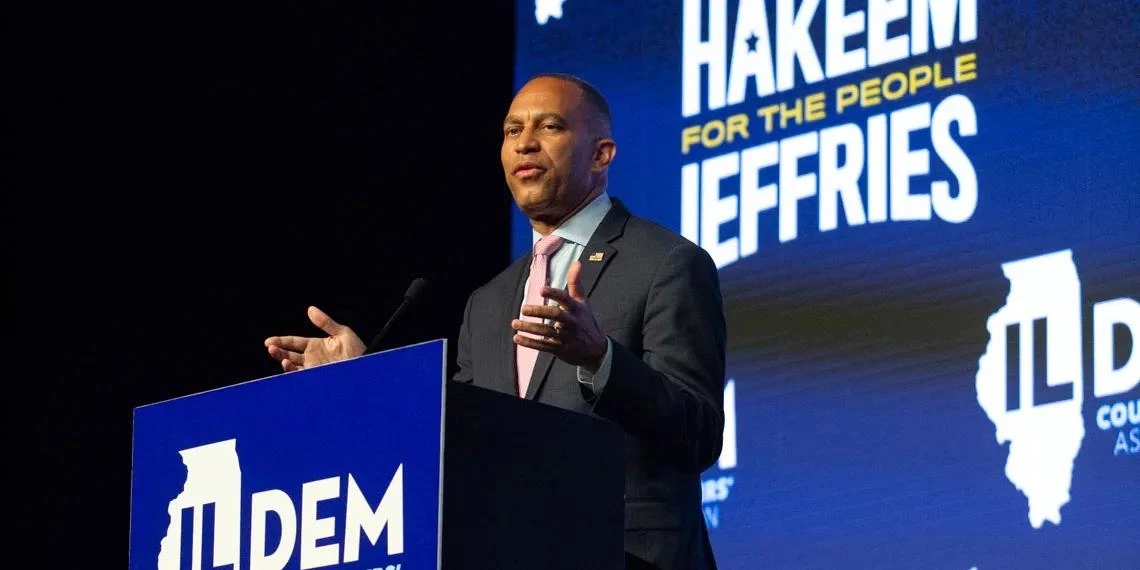
Hakeem Jeffries has served in the U.S. House of Representatives since 2013, representing New York's 8th Congressional District, which covers parts of Brooklyn. He was elected House Minority Leader in November 2022 in a unanimous vote of the Democratic caucus, succeeding longtime Speaker Nancy Pelosi. As the top-ranking House Democrat, Jeffries has spent much of 2026 positioning his party for the November midterm elections, with control of the chamber — and possibly the Senate — at stake.
Jeffries has built his party's midterm pitch around affordability. Roughly 100 days before the election, he unveiled a platform at a campaign stop in Pennsylvania's Lehigh Valley built around wages, housing, healthcare, education, and retirement security. Central planks include rolling back tariffs imposed during the Trump administration, extending enhanced Affordable Care Act tax credits set to expire, and unwinding the Republican budget package passed earlier in the term. He has also pledged support for banning stock trading by the president, vice president, and members of Congress, releasing files related to Jeffrey Epstein, and strengthening federal voting rights protections.
Jeffries has repeatedly argued that the cost of living has risen rather than fallen under the current administration, framing this as the central contrast for voters heading into November.
At a National Association of Black Journalists conference in Atlanta, Jeffries identified restoring voting rights protections and addressing the composition of the Supreme Court as top priorities should Democrats regain control of Congress and the White House. He pointed to the Supreme Court's ruling in Louisiana v. Callais, which weakened the Voting Rights Act of 1965, as accelerating a wave of mid-decade congressional redistricting that he says eroded voting power for Black Americans. He acknowledged that any reform legislation would be unlikely to receive a presidential signature under the current administration, framing the fight instead as a longer-term rebuilding effort contingent on future election outcomes.
Jeffries and Senate Minority Leader Chuck Schumer have taken a hard line on health care, saying they would not support spending legislation that raises premiums or reduces coverage under the Affordable Care Act. Jeffries has warned that without an extension of expiring tax credits, premiums, co-pays, and deductibles would rise sharply for millions of people, and that hospitals, nursing homes, and community health clinics in various states risked closure. This stance has also fed into broader standoffs in Congress over government funding.
Jeffries has expressed public confidence that Democrats will retake the House, citing a string of Democratic wins in off-year elections in New York City, New Jersey, Virginia, and California, along with less-publicized down-ballot results in states such as Georgia, Mississippi, and Pennsylvania. He has described the Senate as a tougher but still viable target. If Democrats win the House, Jeffries is positioned to become Speaker, while committee leaders such as Richard Neal have signaled priorities including renewing health care tax credits and addressing Social Security solvency.