•
•
•
•
•
•
•

From Vyommitra to fruit flies: what ISRO's uncrewed test flight is carrying, and why it is the final checkpoint before Indians fly to space on an Indian rocket
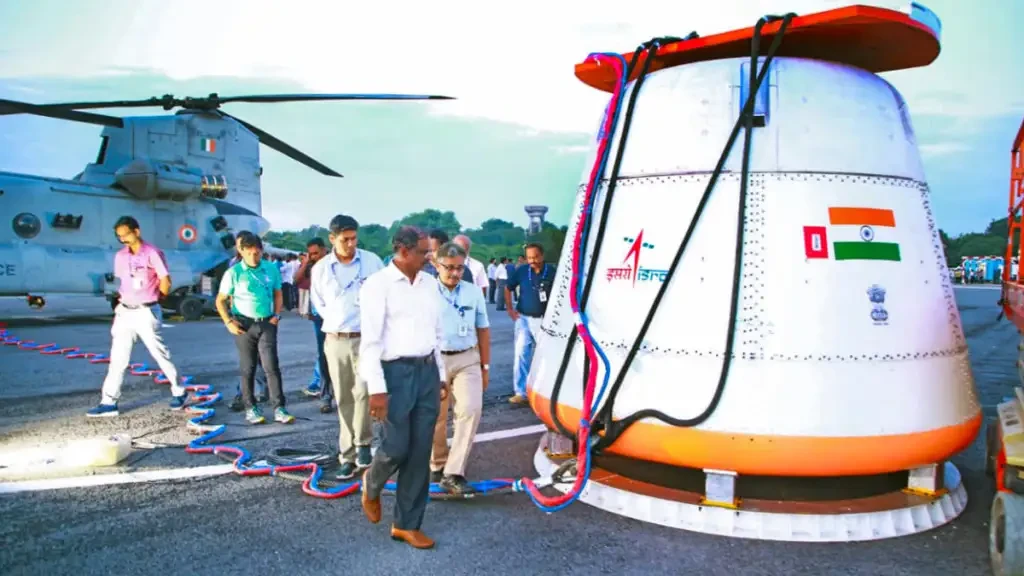
Gaganyaan-1 is the uncrewed test flight in the Indian Space Research Organisation's (ISRO) Gaganyaan programme — India's effort to independently send humans into orbit aboard an Indian rocket. Rather than carrying astronauts, this precursor mission is designed to prove out every critical system — the crew module, life-support systems, and recovery procedures — before India commits to a crewed flight.
ISRO has targeted the second half of 2026 (H2 2026) for the launch, following years of delays and a long sequence of ground and sub-system tests.
No astronauts will fly on Gaganyaan-1. In their place, ISRO is sending a payload designed to simulate human presence and gather the data a crewed mission would need:
Integration of Vyommitra into the crew module began on April 28, 2026, marking a significant step toward flight readiness.
The most significant recent test came on April 10, 2026, when the Gaganyaan-1 crew module successfully underwent an air drop test. An Indian Air Force Chinook helicopter dropped the module from approximately 3 kilometres above the Bay of Bengal to validate its parachute deployment and splashdown behaviour — a critical rehearsal for how the real capsule will return crew safely to Earth after an orbital mission.
Gaganyaan has faced a long history of schedule revisions:
ISRO confirmed the H2 2026 target in a press release issued on January 21, 2026, alongside updates on integration activities and ground infrastructure completion.
If successful, Gaganyaan-1 will be the final major technical checkpoint before ISRO attempts to send Indian astronauts into low Earth orbit — a feat only the United States, Russia and China have achieved independently to date. A successful uncrewed flight would validate the crew module's structural integrity, the life-support systems that keep a cabin habitable, and the recovery operations needed to bring a capsule and its occupants home safely.
Beyond national prestige, an independent human spaceflight capability strengthens India's position in the growing commercial and strategic space economy, supports its ambitions for a future Indian space station, and builds indigenous expertise across aerospace engineering, materials science and life-support technology.
Assuming Gaganyaan-1 meets its objectives in H2 2026, ISRO's roadmap includes:
Will astronauts fly on Gaganyaan-1?
No. Gaganyaan-1 is an uncrewed test flight designed to validate systems before any Indian astronaut flies.
What is Vyommitra?
Vyommitra is a half-humanoid robot developed by ISRO to simulate crew activity and monitor cabin conditions during the uncrewed test flight, providing data that will inform the eventual crewed mission.
Why has Gaganyaan been delayed so many times?
The programme's original 2020 target was disrupted by the COVID-19 pandemic, and subsequent target dates were pushed back multiple times as ISRO worked through the complex testing required for human-rated spaceflight systems.
When will India send actual astronauts to space?
A crewed Gaganyaan mission is expected to follow the uncrewed Gaganyaan-1 test flight, though ISRO has not fixed a public date for the crewed flight as of the H2 2026 target for Gaganyaan-1.
Which countries have independently sent humans to space?
Only the United States, Russia (as the Soviet Union) and China have independently launched humans into orbit. A successful Gaganyaan crewed mission would make India the fourth country to do so.
Gaganyaan-1 represents the final rehearsal before India attempts to put its own astronauts into orbit on an Indian rocket. With crew-module drop tests completed and Vyommitra now integrated, ISRO's programme has moved from paper milestones to hardware readiness — even as the mission's long history of delays is a reminder of just how exacting human-rated spaceflight engineering is.