•
•
•
•
•
•
•

How CRISPR, base editing, and prime editing are moving from lab tool to approved therapy — and the ethical questions that come with them
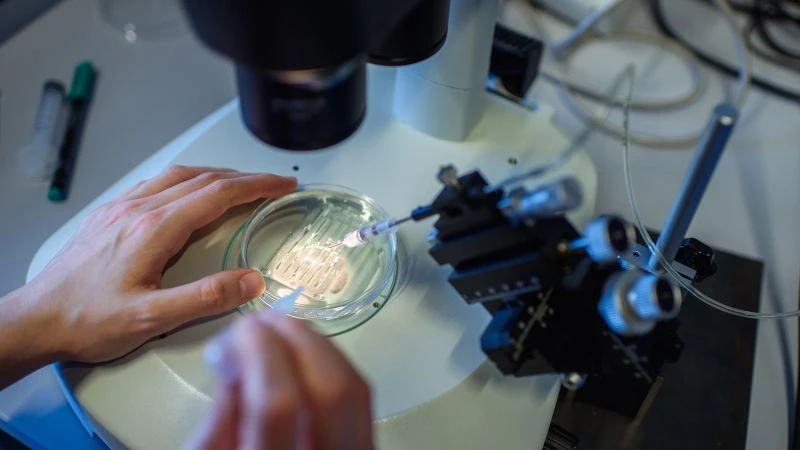
Little more than a decade after CRISPR-Cas9 was first adapted as a gene-editing tool, it has moved from a laboratory technique into approved medicine. As of 2026, one CRISPR-based therapy is approved for treating severe sickle cell disease and beta-thalassemia in multiple countries, and a growing pipeline of trials is testing newer, more precise editing methods — base editing and prime editing — against a wider range of inherited and acquired diseases. Alongside this progress, the same technology continues to raise serious ethical questions, particularly around germline editing, cost, and equitable access.
This guide explains, in plain terms, how CRISPR and its newer variants work, what is medically established versus still experimental, and the debates regulators and bioethicists are actively working through.
CRISPR-Cas9 is adapted from a bacterial immune defence system. In simplified terms:
This "cut-and-repair" mechanism is powerful but imprecise: the cell's repair process can introduce unintended insertions or deletions at the cut site, and cuts can occasionally occur at unintended locations in the genome (so-called off-target effects). This imprecision is the main reason base and prime editing were developed.
Base editing, developed by researchers including David Liu's laboratory, chemically converts one DNA base pair into another (for example, converting an A-T pair to a G-C pair) without cutting both strands of the DNA helix. Because it does not rely on the cell's error-prone double-strand break repair, base editing produces fewer unintended insertions or deletions, making it well suited to correcting the many genetic diseases caused by a single-letter ("point") mutation.
Prime editing, a more recently developed technique, is sometimes described as a "search and replace" tool for DNA. It uses a modified Cas9 enzyme fused to a reverse transcriptase enzyme, guided by a specialised RNA that both identifies the target site and carries the corrected sequence. Prime editing can, in principle, perform a broader range of edits — including small insertions, deletions, and all types of base substitutions — with a lower rate of off-target effects than the original CRISPR-Cas9 cut-and-paste approach.
| Technique | Mechanism | Precision | Best Suited For |
|---|---|---|---|
| CRISPR-Cas9 | Double-strand cut + cell repair | Moderate; some off-target risk | Disabling genes, larger edits |
| Base editing | Direct chemical base conversion, no double-strand cut | Higher | Single-letter point mutations |
| Prime editing | "Search and replace" via reverse transcriptase | Highest, broadest edit types | Insertions, deletions, precise corrections |
The clearest medical success story remains the CRISPR-Cas9-based therapy exagamglogene autotemcel (marketed as Casgevy), which received regulatory approval starting in 2023 for severe sickle cell disease and, subsequently, transfusion-dependent beta-thalassemia. It works by editing a patient's own blood stem cells outside the body (an "ex vivo" approach) to reactivate production of fetal haemoglobin, then reinfusing the edited cells.
Beyond that landmark approval, a substantial and growing number of CRISPR, base-editing, and prime-editing therapies remain in clinical trials rather than approved use, targeting conditions such as:
It is important to distinguish these categories clearly: an approved therapy has cleared rigorous, multi-phase clinical trials and regulatory review; a therapy "in trials" is still being tested for safety and effectiveness and is not yet available as standard medical care. Patients and families researching CRISPR-based treatment options should rely on guidance from qualified physicians and official regulatory-agency resources rather than treating experimental therapies as available treatments.
Beyond human medicine, CRISPR-based gene editing has become an established tool in agriculture, used to develop crop varieties with traits such as disease resistance, improved drought tolerance, and modified nutritional profiles, as well as livestock breeding applications. Several countries have adopted regulatory frameworks that treat certain gene-edited crops (particularly those without inserted foreign DNA) differently from older-generation genetically modified organisms, though rules vary significantly by country and continue to evolve.
A sharp ethical line separates somatic gene editing — changes made to a patient's body cells that are not passed to offspring — from germline editing, which alters eggs, sperm, or early embryos in ways that would be inherited by future generations. The scientific and bioethics community has treated heritable human germline editing as off-limits for clinical use following the widely condemned 2018 case of a researcher who edited human embryos that resulted in live births, an act that violated international scientific consensus and led to his prosecution in China. As of 2026, no country has approved heritable human germline editing for clinical reproduction, and most scientific bodies continue to call for continued moratoria pending broader societal and international consensus.
Approved CRISPR therapies remain extraordinarily expensive — list prices for Casgevy have been reported in the range of two to three million dollars per patient in the United States — raising serious concerns about who can actually access these treatments. This is especially significant because diseases like sickle cell disease disproportionately affect populations in lower-income countries and underserved communities within wealthier ones, where the infrastructure for stem-cell collection, editing, and reinfusion is often unavailable regardless of cost. Health policy researchers and global health organisations continue to debate manufacturing, licensing, and financing models that could widen access.
Because gene-editing therapies are new, questions remain about long-term safety monitoring, informed consent for irreversible interventions, and the adequacy of regulatory oversight across different countries with varying review standards. Regulators including the US FDA, the European Medicines Agency, and equivalent bodies elsewhere require extensive trial data and post-approval monitoring, but the field's rapid pace means oversight frameworks are still maturing alongside the science.
Regulatory approaches differ across major jurisdictions:
CRISPR-based medicine represents one of the most significant shifts in how genetic disease is treated — moving from lifelong symptom management toward potentially curative, one-time interventions for certain conditions. At the same time, its cost, complexity, and ethical stakes mean that its benefits are not yet distributed evenly, and the technology's most consequential long-term applications — particularly anything touching the human germline — remain deliberately constrained by international scientific consensus rather than technical limitation alone.
Is CRISPR gene editing the same as older genetic engineering?
No. Older genetic engineering techniques typically inserted foreign genetic material somewhat imprecisely; CRISPR and its newer variants (base and prime editing) are designed to make precise, targeted changes at specific locations in the genome.
Can CRISPR cure sickle cell disease?
An approved CRISPR-based therapy (Casgevy) has shown strong clinical results for reducing or eliminating severe pain episodes in patients with severe sickle cell disease, based on published trial data, but it is a complex, resource-intensive procedure available only through specialised treatment centres, not a simple universally accessible cure.
Is it legal to edit human embryos with CRISPR?
Editing embryos for research purposes is permitted under strict oversight in some countries; using edited embryos to establish a pregnancy (heritable germline editing) is not approved for clinical use anywhere as of 2026 and is widely regarded as unethical under current international scientific consensus.
What is the difference between somatic and germline editing?
Somatic editing changes cells in a living person's body and is not inherited by their children. Germline editing changes reproductive cells or early embryos in ways that would be passed on to future generations — which is why it is treated with far greater caution.
CRISPR gene editing has crossed a genuine threshold: it is no longer purely experimental, with at least one therapy now an approved medical treatment and a substantial pipeline of base- and prime-editing therapies advancing through clinical trials. The technology's next chapter will be defined less by whether it works — the core science is increasingly well established — and more by how societies resolve the harder questions of cost, access, oversight, and the enduring, deliberate boundary around heritable human genome editing.