•
•
•
•
•
•
•

Moving beyond recycling toward business models built around reuse, repair, and material recovery
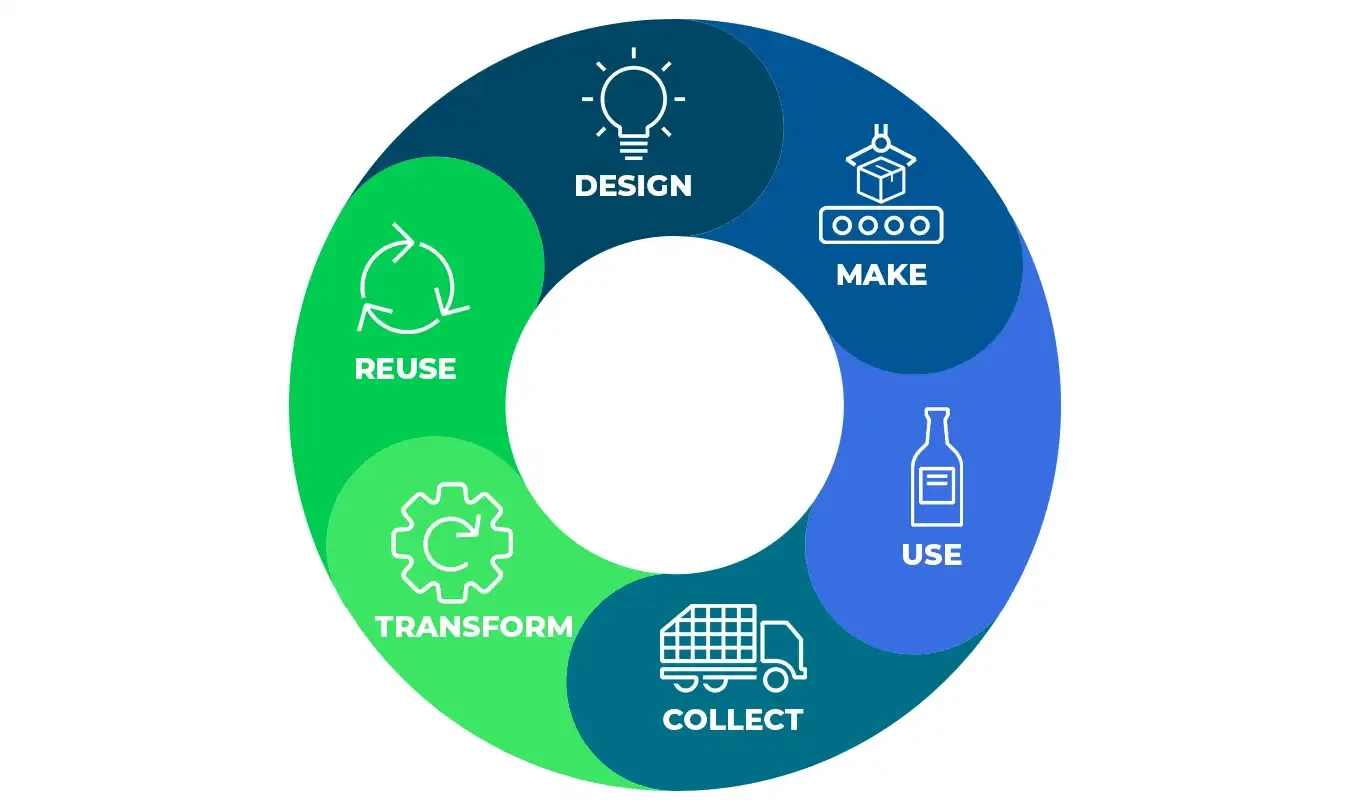
The circular economy is an economic model that aims to keep materials and products in productive use for as long as possible, contrasting with the traditional "linear" economic model of extracting raw materials, manufacturing products, using them, and then disposing of them as waste. Circular approaches emphasize designing products for durability, repair, and eventual disassembly, so that materials can be recovered and reused rather than ending up in landfills once a product reaches the end of its initial use.
This is a broader concept than recycling alone. While recycling recovers materials after a product has already been discarded, circular economy thinking aims to design waste out of the system from the start, considering a product's entire lifecycle before it is even manufactured.
Businesses have adopted circular principles through several distinct strategies:
Several factors are driving business interest in circular economy models. Rising and volatile raw material costs have made resource efficiency more financially attractive, since recovering and reusing materials can reduce dependence on newly extracted resources. Regulatory pressure in some regions has also increased, with policies increasingly holding manufacturers responsible for a product's end-of-life impact. Additionally, growing consumer interest in sustainability has created market demand for products designed with circularity in mind, though this demand varies significantly across different markets and product categories.
| Challenge | Description |
|---|---|
| Design complexity | Products must be engineered for disassembly and repair from the outset, often requiring significant redesign |
| Reverse logistics | Collecting used products for refurbishment or material recovery adds operational cost and complexity |
| Consumer behavior | Take-back and repair programs depend on consumer participation, which varies significantly |
| Economic viability | Circular processes must compete economically with cheaper, linear alternatives in many markets |
Expect continued regulatory development around extended producer responsibility policies in multiple regions, alongside growing investment in reverse logistics infrastructure needed to make large-scale product take-back and refurbishment economically viable. Industries with high material costs or significant regulatory pressure, including electronics and certain manufacturing sectors, are likely to remain at the forefront of circular economy adoption.
Is the circular economy the same as recycling?
No. Recycling is one component of circular economy thinking, but the broader concept also includes product design for durability and repair, business models built around reuse, and minimizing waste generation from the outset rather than managing it only after disposal.
Which industries are leading in circular economy adoption?
Industries with high material costs or strong regulatory pressure, such as electronics, textiles, and certain manufacturing sectors, have generally been early adopters of circular business models.
Does circular economy thinking cost businesses more money?
It can involve higher upfront design and logistics costs, but businesses often find long-term savings through reduced material costs and new revenue streams from refurbished products or material recovery, depending on the specific model adopted.
How can consumers participate in the circular economy?
Participating in manufacturer take-back and repair programs, choosing durable and repairable products, and properly using available recycling and refurbishment options are common ways consumers contribute to circular economy goals.
The circular economy represents a fundamental rethinking of how products are designed and used, aiming to keep materials productive for as long as possible rather than treating disposal as inevitable. While scaling these approaches remains challenging, growing regulatory and market pressures are likely to continue pushing more businesses toward circular design principles.