•
•
•
•
•
•
•

Discover Chuseok, Korea's biggest harvest festival — its ancient origins, family traditions, iconic songpyeon rice cakes, and how it's celebrated across the world.
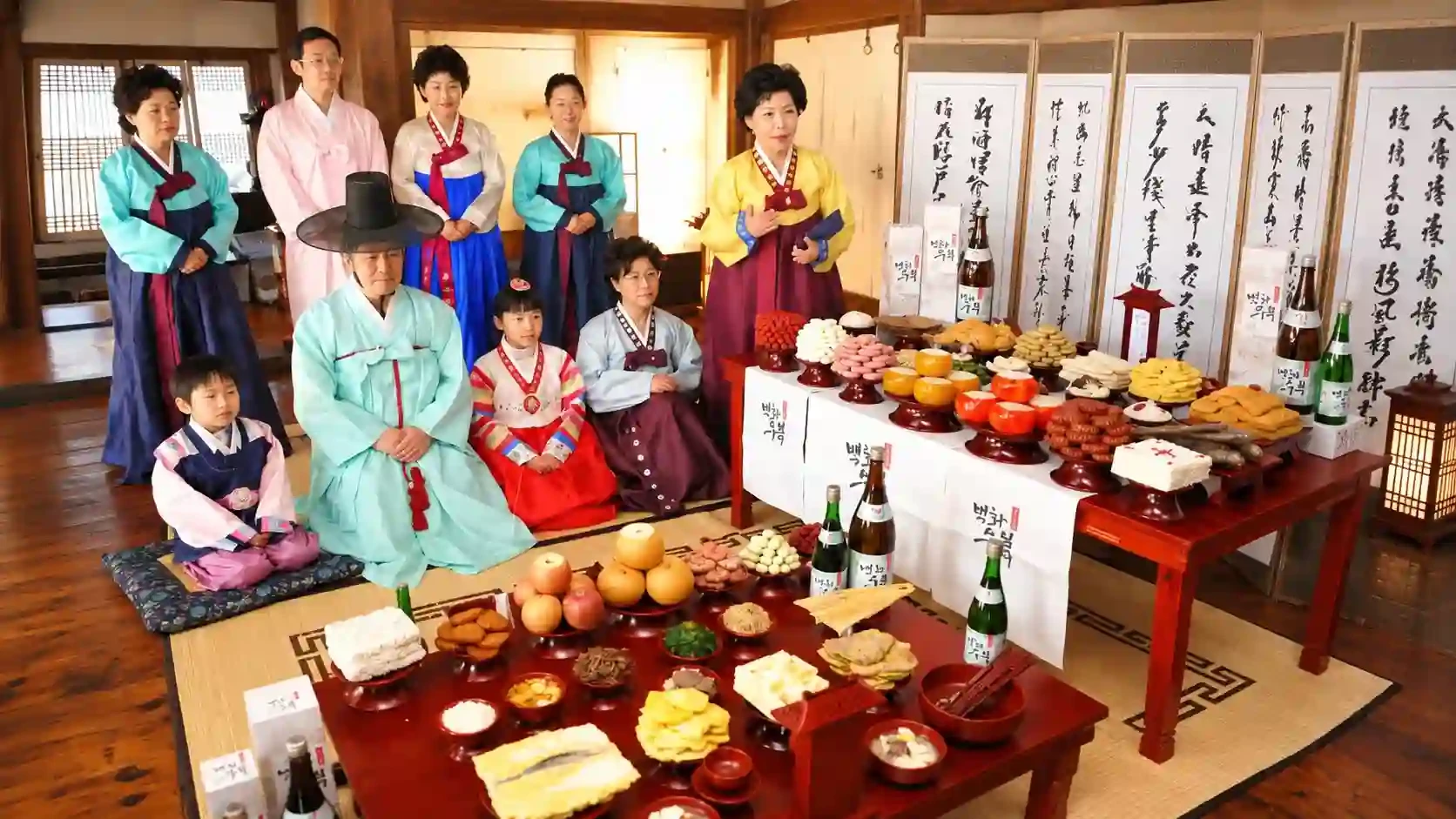
Chuseok (추석), literally meaning "autumn evening," is a major Korean harvest festival celebrated on the 15th day of the 8th month of the lunisolar calendar — the night of the year's fullest autumn moon. Also known as Hangawi ("the great middle of autumn"), it's one of the two most important holidays in Korea, alongside Lunar New Year. In South Korea, the celebration spans three days, while North Korea observes it as a single-day holiday. This year, Chuseok falls on September 24–26, 2026.
Often translated as "Korean Thanksgiving" for Western audiences, Chuseok is really its own distinct tradition — rooted far more deeply in ancestor worship and the lunar calendar than in the American holiday it's sometimes compared to.
The roots of Chuseok trace back roughly two thousand years to the ancient kingdom of Silla. According to popular legend, the holiday originated from gabae, a month-long weaving contest held between two teams during the reign of Silla's third king. The losing team would treat the winners to a grand feast — complete with food, dance, and games — which many historians believe evolved into the celebration we recognize today. Other scholars trace Chuseok's roots to ancient shamanistic harvest-moon worship, where communities offered thanks to local deities and ancestors for a successful harvest.
Two customs sit at the heart of Chuseok:
Millions of South Koreans travel back to their hometowns during Chuseok to take part in these rituals, creating some of the country's heaviest travel congestion of the year — flights are known to sell out three months in advance, and roads and hotels become severely overcrowded.
No Chuseok celebration is complete without songpyeon, a half-moon-shaped rice cake steamed over pine needles and filled with ingredients like sesame seeds, chestnuts, red beans, or honey. The half-moon shape carries symbolic weight tied to an old legend about the rival kingdoms of Baekje and Silla, and Koreans believe eating songpyeon under the full moon brings a brighter future.
Other festive dishes include:
Beyond the feast, Chuseok is a time for community and play. Ssireum, Korean traditional wrestling with roots dating back roughly 5,000 years to the Goguryeo dynasty, remains the most popular Chuseok sport, with winners historically earning a bull and a bag of rice. Other customs include Ganggangsullae, a circular folk dance performed by women under the full moon, and Juldarigi, a village-wide tug-of-war believed to predict the year's harvest fortunes.
While the heart of Chuseok remains family gatherings and ancestral rites, modern celebrations have expanded well beyond Korea's borders. Institutions like the Smithsonian's National Museum of Asian Art in Washington, D.C. host public Chuseok programming each year, offering visitors a chance to experience Korean culture, crafts, and cuisine even outside Korea. Gift-giving has also become a significant part of the modern holiday — a tradition that started in the 1960s with simple daily necessities and has since evolved into elaborate gift sets, sometimes commanding astonishingly high price tags for luxury items like wild pine mushrooms or red ginseng.
Chuseok is also closely related to other harvest festivals celebrated across Asia around the same lunar date, including China's Mid-Autumn Festival, Japan's Tsukimi, and Vietnam's Tết Trung Thu — each with its own unique flavor of moon-gazing and seasonal celebration.