•
•
•
•
•
•
•

Axiom Gas Engineering Limited has opened its initial public offering on September 18, 2026, bringing its PrimeFuel Auto LPG business to the NSE SME platform. With improving revenue and profit, more than 20 Auto LPG dispensing stations and fresh capital planned for expansion, the IPO has attracted investor attention. However, its SME status, Auto LPG concentration and valuation are factors investors may want to examine before making a decision.
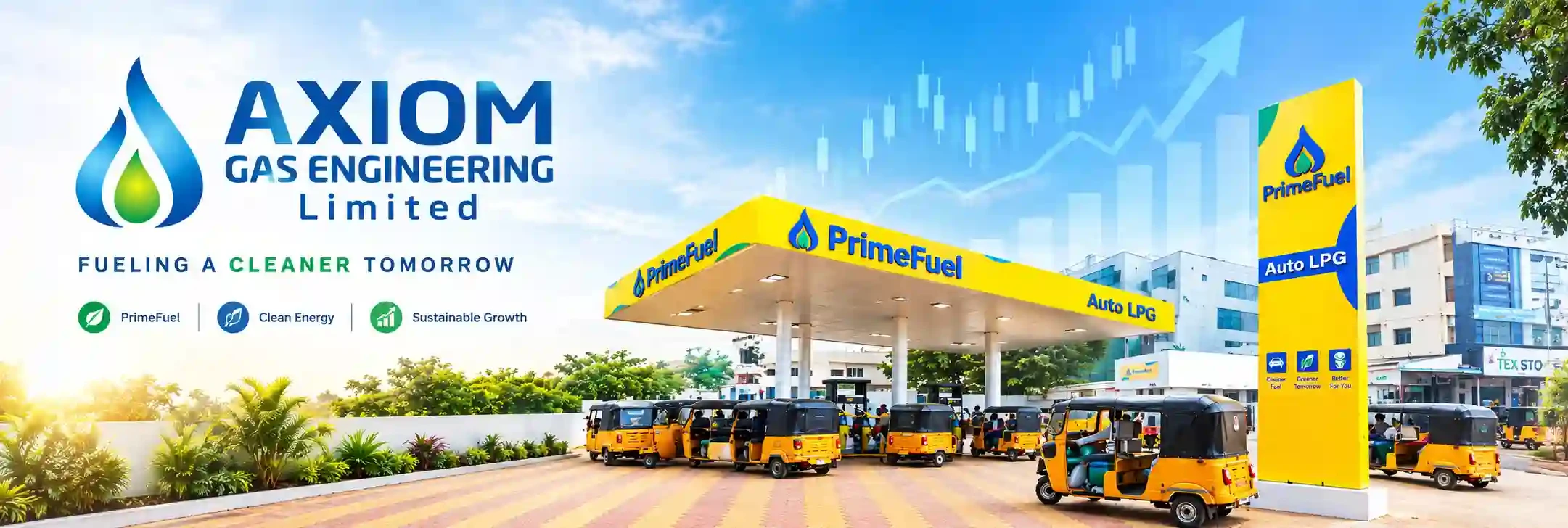
Axiom Gas Engineering's IPO has opened for public subscription, putting the company in focus among investors tracking India's SME IPO market.
The issue will remain open until September 22, with the basis of allotment expected on September 23 and the shares proposed to list on NSE's SME platform on September 25.
The company is raising fresh capital rather than offering an existing shareholder exit through an offer-for-sale component.
| Particular | Details |
|---|---|
| Company | Axiom Gas Engineering Limited |
| Brand | PrimeFuel |
| IPO Type | Fresh Issue |
| Issue Size | Around ₹50.75 crore |
| Price Band | ₹51–₹54 per share |
| Lot Size | 2,000 shares |
| Minimum Retail Application | 4,000 shares |
| Minimum Investment at Upper Band | ₹2.16 lakh |
| IPO Opens | September 18, 2026 |
| IPO Closes | September 22, 2026 |
| Expected Allotment | September 23, 2026 |
| Tentative Listing | September 25, 2026 |
| Exchange | NSE SME |
At the upper price of ₹54, one 2,000-share lot represents ₹1.08 lakh, while the minimum retail application of two lots represents ₹2.16 lakh.
Axiom Gas Engineering operates in the gas and clean-energy infrastructure segment, with its most visible consumer-facing business operating under the PrimeFuel brand.
The company runs more than 20 Auto LPG Dispensing Stations across Telangana, Karnataka and Maharashtra. Its business model involves procuring Auto LPG, storing and transporting it and selling it to customers through its dispensing network.
The company also has activities related to gas engineering, LPG and CNG infrastructure, turnkey solutions, testing and certification, maintenance and technical services.
This gives investors exposure not simply to a fuel-station network, but to a broader gas engineering and infrastructure business.
Axiom's financial numbers have improved over the past few years.
For FY2026, the company reported total income of about ₹100.78 crore, compared with approximately ₹89.85 crore in FY2025. Profit after tax increased to around ₹9.45 crore, from ₹7.75 crore in FY2025.
That represents growth in both revenue and profit, while the company's reported PAT margin also improved over the period.
The company's financial performance is therefore one of the major factors investors may examine when assessing the IPO.
A substantial portion of the proceeds is intended for business expansion.
According to the company's IPO disclosures, around ₹27.60 crore is earmarked for capital expenditure, while approximately ₹9.1 crore is intended for repayment or prepayment of borrowings. The remaining proceeds are planned for general corporate purposes.
The proposed use of funds means the IPO is partly aimed at strengthening the company's operating capacity rather than being primarily an exit for existing shareholders.
The company has also attracted anchor investor participation, with reports indicating that around ₹5.78 crore was raised from anchor investors at the upper end of the price band.
However, anchor participation should not by itself be treated as an indication of future stock performance. IPO investors still need to examine the company's financial statements, valuation, business risks and the terms outlined in its offer documents.
There are several factors that may attract attention to Axiom Gas Engineering.
Growing PrimeFuel network: More than 20 Auto LPG dispensing stations provide an established operating base.
Improving financial performance: Revenue and profit have increased between FY2025 and FY2026.
Expansion capital: A significant portion of IPO proceeds is intended for capital expenditure.
Established business: The company has been operating in the gas and Auto LPG segment for years rather than being an entirely new business.
Clean-energy positioning: Auto LPG and gas infrastructure give the company exposure to India's broader transition toward alternative fuel and energy infrastructure.
At the same time, investors should not look at the growth numbers in isolation.
One important consideration is business concentration. Axiom's operations are heavily dependent on Auto LPG, meaning changes in fuel prices, consumer preferences, competition or government policy could affect demand.
The company also has supplier concentration, with a significant portion of procurement coming from a relatively small number of suppliers. Any disruption in these relationships could affect operations.
Another consideration is SME IPO risk. Shares listed on SME platforms can have lower trading liquidity than larger mainboard companies, and investors may face greater price volatility.
Valuation is another point to study. Based on FY2026 earnings and the upper IPO price, market sources have estimated a post-issue P/E of roughly 19.85 times. Investors may therefore want to compare the valuation with the company's growth rate, profitability, business risks and comparable companies before reaching their own conclusion.
The grey market premium, or GMP, is often closely followed during an IPO because it can provide an informal indication of market sentiment before listing.
For Axiom Gas Engineering, no meaningful GMP was being reported at the time the IPO opened. However, GMP is an unofficial market indicator, is not regulated like the actual exchange price and can change quickly.
Therefore, investors should avoid treating GMP alone as a reason to participate in an IPO.
There is no single answer that applies to every investor.
Axiom Gas Engineering presents a combination of business growth, an established PrimeFuel network, improving profitability and planned expansion, but these factors come alongside Auto LPG concentration, supplier dependence, SME-market risks and valuation considerations.
For investors studying the IPO, the more useful approach may be to evaluate the company's financial performance, valuation, debt position, expansion plans, industry outlook and risk disclosures together.
Investors should also remember that the minimum retail application is relatively high at ₹2.16 lakh at the upper price band. That makes position sizing and risk management particularly relevant for smaller investors.
The IPO may therefore be best understood as an opportunity to gain exposure to a niche Auto LPG and gas-engineering business, rather than simply viewing it through the lens of its opening-day market excitement.
Axiom Gas Engineering's IPO brings the PrimeFuel Auto LPG business to the public market at a time when the company is reporting higher revenue and profitability and planning additional capital expenditure.
The key question for investors is not simply whether the company is growing, but whether that growth can continue, whether the valuation adequately reflects the risks and whether the business can diversify and scale beyond its current dependence on Auto LPG.
Investors considering the issue should study the company's Red Herring Prospectus, financial statements, valuation and risk factors before deciding whether the IPO fits their investment objectives and risk tolerance.