•
•
•
•
•
•
•

How Roman engineers built infrastructure so durable that parts of it remain in use two thousand years later
Two thousand years after the fall of the Western Roman Empire, people still drive on roads that trace Roman routes, drink water that once flowed through Roman aqueduct channels, and stand beneath a concrete dome the Romans built without a single piece of steel reinforcement. Roman engineering did not just serve its own time — it set a technical benchmark that took the modern world centuries to match.
The Romans did not invent roads, arches, or concrete. What they did was combine standardized methods, disciplined logistics, and durable materials into infrastructure systems built at an imperial scale, connecting a territory that stretched from Britain to the Persian Gulf.
At its height, the Roman road network covered roughly 80,000 kilometers (about 50,000 miles) of major roads, with tens of thousands more kilometers of secondary routes connecting towns, forts, and ports across the empire.
Roman road builders followed a layered construction method designed for drainage and long-term stability:
Roads were built with a slight camber (a curved cross-section) so rainwater drained toward ditches on either side, preventing the kind of waterlogging that destroys unpaved roads. Major highways like the Via Appia (Appian Way, begun 312 BCE) and the Via Egnatia connected Rome to its provinces and allowed legions, officials, and goods to move at a pace unmatched in the ancient world.
Road-building was a state project run with military precision:
Rome's eleven major aqueducts supplied the city with an estimated 1 million cubic meters of water per day at the empire's peak, serving public baths, fountains, and private households.
Roman aqueducts relied almost entirely on gravity flow. Engineers surveyed routes over dozens of kilometers, maintaining a gentle, continuous downward gradient — sometimes as shallow as a few centimeters of drop per kilometer — from a water source to the city.
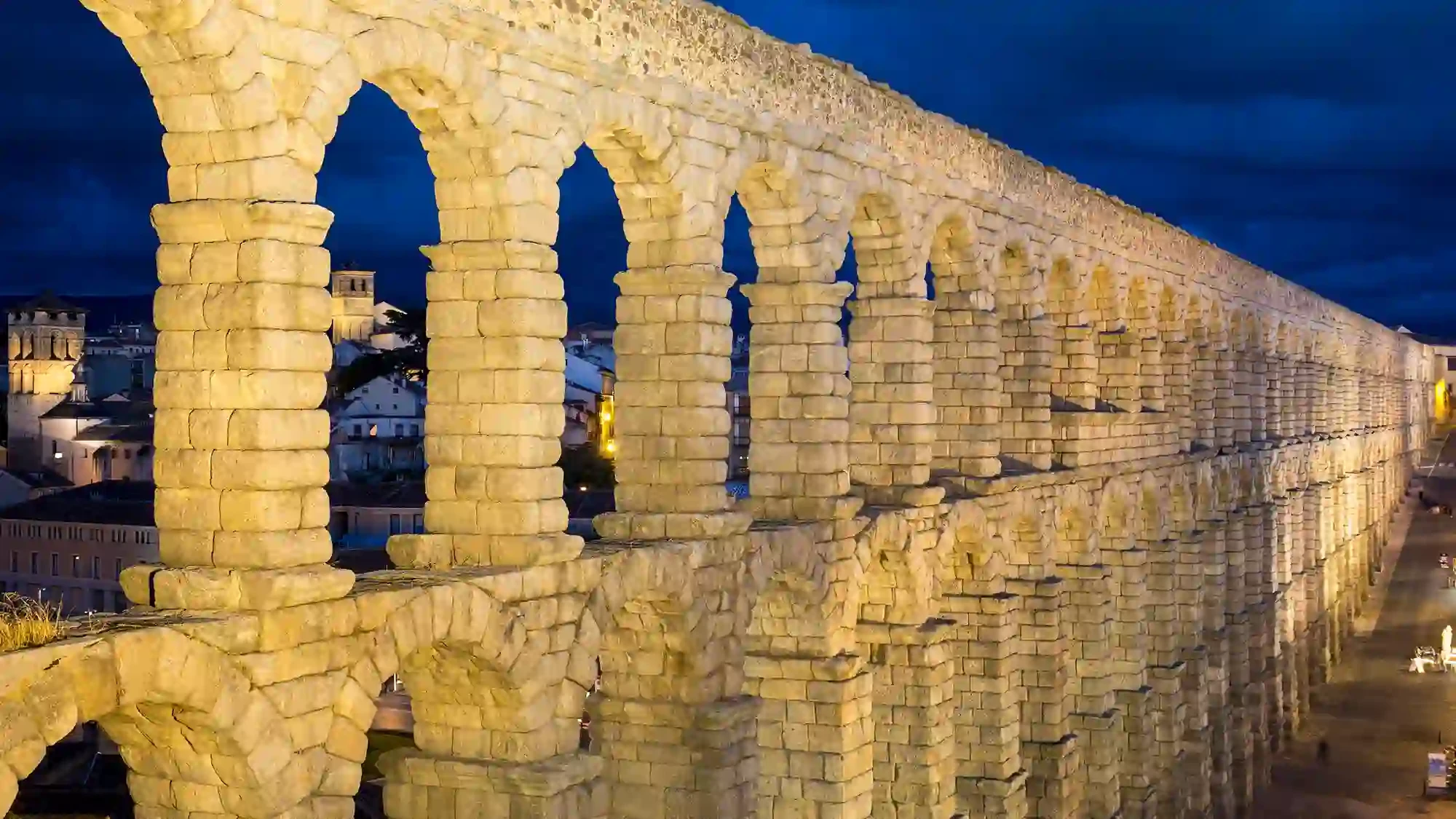
Most of an aqueduct's length ran underground in covered channels, which protected the water and avoided the enormous cost of building elevated structures everywhere. Elevated arched sections — the dramatic stone arcades most people picture — were only built where the land dipped and the channel needed to be carried across a valley to keep the gradient consistent.
| Aqueduct/Structure | Location | Notable Feature |
|---|---|---|
| Pont du Gard | Nîmes, France | Three-tiered arched bridge, still structurally intact |
| Aqueduct of Segovia | Segovia, Spain | Built without mortar in its visible arches, over 800 meters of granite arcade |
| Aqua Claudia | Rome, Italy | One of Rome's largest aqueducts, sections still visible |
| Eifel Aqueduct | Cologne, Germany | Over 95 km long, among the longest in the Roman world |
Roman engineers also used inverted siphons — sealed lead or stone pipes — to carry water down into a valley and back up the other side under pressure, when building a full arched crossing was impractical.
Opus caementicium, Roman concrete, is one of the most studied materials in engineering history because so much of it has survived intact for two millennia, while modern reinforced concrete often degrades within decades.
Roman concrete combined:
The reaction between lime and volcanic ash created a naturally durable binding compound. Research published in recent years — including analysis by MIT and Harvard researchers — found that Roman concrete used a technique called hot mixing, incorporating lumps of unmixed quicklime that reacted with water intrusion over time. When tiny cracks formed, water seeping in reacted with these lime clasts to form new calcium carbonate crystals that filled the cracks — a built-in, ongoing self-healing process.
Concrete exposed to seawater, such as in Roman harbor structures, shows an additional mechanism: seawater reacting with volcanic ash minerals over centuries actually strengthened the material rather than degrading it, as aluminous tobermorite crystals grew within the concrete's structure.
Modern reinforced concrete typically relies on steel rebar for tensile strength. Steel corrodes when exposed to water and air, expanding and cracking the surrounding concrete from within — a failure mode Roman concrete, without steel reinforcement, never faced. Roman engineers instead relied on the compressive strength of arches, domes, and thick unreinforced masses.
Roman infrastructure investment was driven by practical necessity as much as ambition:
Rome also standardized construction knowledge. The architect and engineer Vitruvius, writing in the 1st century BCE, documented building methods, materials, and water systems in De Architectura, a text that later influenced Renaissance and modern engineers who rediscovered Roman techniques.
Roman engineering remains relevant well beyond historical curiosity:
Why does Roman concrete last longer than modern concrete?
Roman concrete's lime-and-volcanic-ash mixture created a self-healing chemical process, and unlike most modern reinforced concrete, it contains no steel rebar to corrode and crack the structure from within.
How long were Roman roads, in total?
Estimates put Rome's major paved road network at roughly 80,000 kilometers, with a much larger network of secondary roads connecting the full extent of the empire.
Did Romans invent concrete?
No. Concrete-like materials predate Rome, but Roman engineers refined the formula — particularly by incorporating volcanic ash — and used it at a scale and for durability no earlier civilization achieved.
Can Roman concrete techniques be used in modern construction?
Researchers are actively studying Roman hot-mixing and self-healing mechanisms to develop more durable, lower-emission concrete, though full-scale modern adoption is still in the research and pilot stage.
Why were Roman roads built with a curved surface?
The camber allowed rainwater to drain to the sides instead of pooling on the surface, which prevented erosion and kept roads usable in wet weather.
Roman roads, aqueducts, and concrete were not isolated technical achievements — they were interlocking systems built with a shared philosophy: durability, standardization, and practical problem-solving at scale. That philosophy is why the Pantheon's dome still stands unsupported, why sections of the Appian Way remain walkable, and why modern material scientists are still studying a concrete recipe developed nearly two millennia ago. Few civilizations have left infrastructure that continues to function, or at least continues to teach, this long after it was built.