•
•
•
•
•
•
•

The 18th BRICS Summit in New Delhi brings together major emerging economies to discuss trade, investment, technology, development and global cooperation.
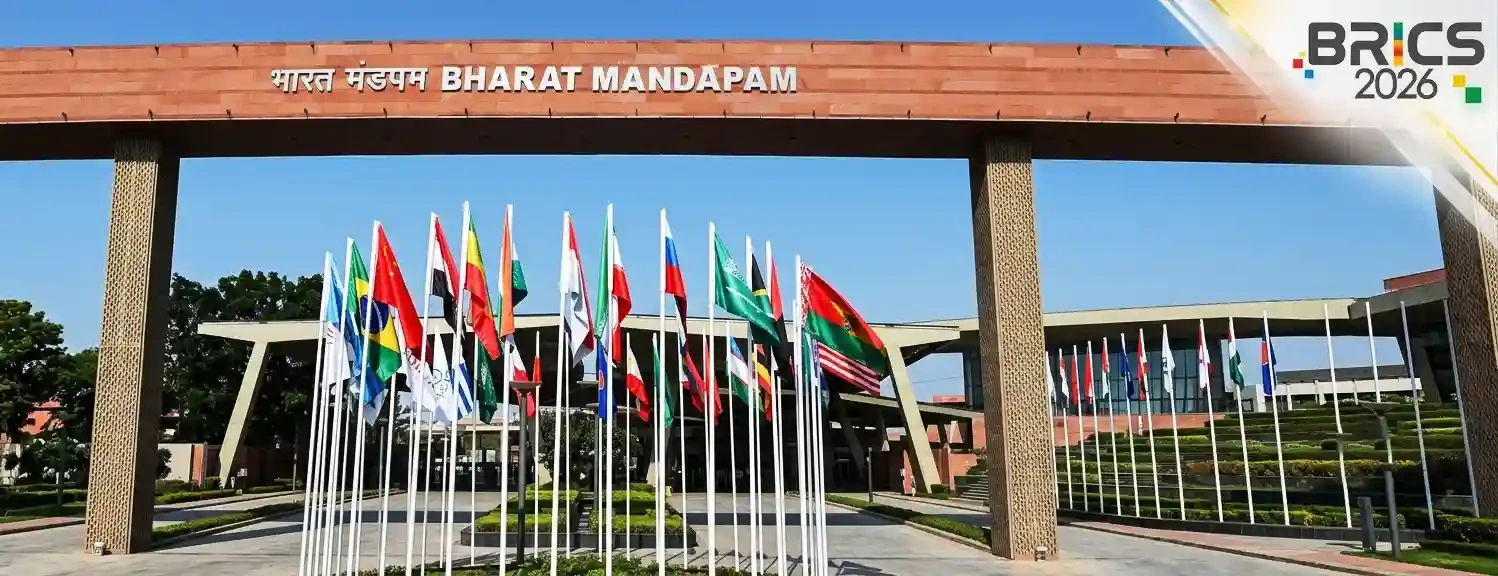
The 18th BRICS Summit is taking place in New Delhi on September 12–13, 2026, with India hosting the grouping for the fourth time. Leaders from BRICS member countries, along with partner countries and invited representatives, are gathering at Bharat Mandapam as the group discusses some of the major economic, political and development challenges facing the world.
But what exactly is BRICS? Why does the summit matter? And how can cooperation between these countries affect the global economy?
To understand the importance of the 18th summit, it helps to first understand how BRICS has evolved.
BRICS is a grouping of major emerging economies that provides a platform for countries to cooperate on economic, financial, political and development-related issues.
The name originally came from Brazil, Russia, India and China, which were grouped together as the “BRIC” economies. South Africa joined in 2010, turning BRIC into BRICS.
The grouping has since expanded considerably.
Today, BRICS has 11 full members:
Together, these countries account for around 49.5% of the world's population, 40% of global GDP and 26% of global trade, according to India's Ministry of External Affairs.
This expansion has changed BRICS from a small group of emerging economies into a much broader platform representing a significant part of the developing world.
The idea behind BRICS was not simply to create another international organisation.
The countries wanted a stronger platform where emerging economies could:
For many developing countries, institutions created decades ago do not always reflect the economic realities of the modern world.
BRICS therefore provides an additional platform through which emerging economies can discuss how the global financial and political system should evolve.
BRICS holds a summit each year, with the presidency rotating among its members.
In 2026, India is the BRICS chair and is hosting the 18th summit in New Delhi. This is India's fourth BRICS chairship, following its earlier presidencies in 2012, 2016 and 2021.
India's theme for the 2026 chairship is:
“Building for Resilience, Innovation, Cooperation and Sustainability”
The broader vision is “Humanity First.”
The idea is to focus BRICS cooperation on practical issues that affect countries and their populations, including economic development, technology, sustainability, education, health and resilience.
The year is also significant because 2026 marks 20 years since the establishment of BRICS.
The summit comes at a time when the global economy is facing several challenges.
Trade tensions, disruptions to energy and supply chains, geopolitical conflicts, technological competition and climate-related pressures are affecting countries across the world.
Against this backdrop, BRICS discussions are expected to cover areas such as:
Increasing trade among member countries is one of the most important areas of BRICS cooperation.
Greater trade can create new markets for businesses, increase exports and imports, and provide companies with access to a larger consumer base.
BRICS includes both major energy producers and large energy-consuming economies.
That makes energy cooperation particularly important, especially as countries deal with changing oil and gas markets, supply disruptions and the transition towards cleaner energy.
Technology is becoming increasingly important to economic growth.
BRICS countries are exploring cooperation in areas such as artificial intelligence, digital infrastructure, fintech, innovation and digital payments.
India has also been pushing discussions around improving cross-border payment connectivity between BRICS economies. However, this remains an area of discussion and cooperation rather than an already-established common BRICS currency system.
Climate change, renewable energy, green finance and sustainable infrastructure are also important parts of the wider BRICS agenda.
For developing economies, the challenge is not simply reducing emissions. It is also finding enough financing and technology to grow while making that growth more sustainable.
Recent global disruptions have shown how quickly problems in one region can affect food, energy and essential goods elsewhere.
BRICS countries are therefore looking at ways to make critical supply chains more resilient.
The benefits of BRICS are not necessarily immediate or automatic. They depend on how effectively member countries turn discussions into practical cooperation.
Closer relationships between BRICS countries can make it easier for businesses to enter new markets.
For example, an Indian company looking to expand into another BRICS economy could potentially benefit from stronger trade links, improved connectivity and easier financial transactions.
BRICS can provide opportunities for countries to attract investment into infrastructure, manufacturing, energy, technology and other sectors.
Investment cooperation can be particularly important for developing economies that need large amounts of capital for long-term projects.
Some BRICS countries are interested in increasing the use of local currencies in trade and developing more efficient cross-border payment mechanisms.
The objective is not necessarily to replace the US dollar overnight. Instead, countries are exploring whether greater use of national currencies and improved payment systems can make certain transactions easier and less dependent on traditional financial channels.
One of the biggest advantages of BRICS is its collective weight.
When countries representing nearly half of the world's population speak through a common platform, their views can carry greater international attention.
This is particularly relevant when discussions involve reforms to global financial institutions and international governance.
BRICS has also created institutions such as the New Development Bank, which focuses on financing infrastructure and sustainable development projects.
Such institutions can provide an additional source of funding for developing countries.
The growing size of BRICS has made the group increasingly important to the global economy.
Its members include major manufacturing economies, large consumer markets, energy producers, agricultural powers and technology-driven economies.
That combination gives BRICS significant economic potential.
However, size alone does not guarantee influence.
The countries have very different economic structures and political interests. China has a much larger economy than most other members, while countries such as India, Brazil, Russia and Saudi Arabia have very different economic priorities.
This means BRICS has to find areas where its members can realistically work together.
This is one of the most frequently asked questions about BRICS.
No common BRICS currency currently exists.
There have been discussions about reducing dependence on the US dollar and improving local-currency trade, but creating a single currency for 11 countries would be an extremely complicated process.
Instead, current efforts are more focused on cross-border payments, local-currency settlements and financial connectivity.
India, for example, has been advocating greater interoperability between digital currencies and payment systems, although significant technical and political challenges remain.
So, the idea of BRICS suddenly replacing the dollar with a common currency should not be confused with the practical discussions currently taking place.
For India, hosting the 18th summit is both an economic and diplomatic opportunity.
India can use its BRICS presidency to push issues that are important to its own development priorities, including technology, digital payments, entrepreneurship, infrastructure, sustainability and the interests of developing countries.
It also gives India an opportunity to engage simultaneously with countries such as China and Russia while maintaining its wider relationships with the United States, Europe and other partners.
That makes India's role particularly important.
The challenge is to keep BRICS focused on practical cooperation rather than allowing differences between members to dominate the group's agenda.
Despite its growing influence, BRICS faces several challenges.
Its members do not always agree with each other.
India and China have their own strategic and economic differences. Russia's relationship with Western countries is very different from India's. Middle Eastern members also have their own regional interests.
The expansion of BRICS has made the group more representative, but it has also made reaching consensus more complicated.
This is why the success of the summit cannot simply be measured by how many countries attend.
The more important question is whether members can find practical areas of cooperation despite their differences.
The 18th BRICS Summit is still underway, so its final outcomes should not be assumed in advance.
Leaders are discussing issues including global governance, trade, investment, technology, food and energy security, sustainability and international developments. The summit is expected to conclude with a New Delhi Declaration, which will outline the group's agreed positions and future direction.
The significance of the summit therefore lies not only in individual announcements, but in what BRICS can realistically achieve after the leaders return home.
BRICS has come a long way from its beginnings as a group of four emerging economies.
It now brings together 11 countries spanning Asia, Africa, the Middle East and South America, representing a substantial share of the world's population and economic activity.
The 18th summit is therefore about more than meetings between heads of government.
It is part of a larger conversation about who gets a voice in the global economy, how emerging economies can work together and what the international economic system should look like in the years ahead.
For India, the summit is an opportunity to demonstrate leadership. For other BRICS members, it is a chance to deepen economic and development cooperation. And for the global economy, the real test will be whether this increasingly diverse group can turn its growing size and influence into meaningful, practical cooperation.